
Flood mock drill: how to run one with community sirens
A practical guide for district teams and village committees on planning a flood drill, agreeing what each siren sound means, timing the warning chain and writing a report that leads to change.

A siren on a pole is only half of a warning. The other half is the people who hear it and know what to do. A flood mock drill is how a district or a village finds out whether that second half works before the river rises. This guide is for the officials, volunteers and committees who plan one.
What is a mock drill and what is its purpose?
A mock drill is a practice response to a pretend emergency in which people and equipment actually move, and one task is repeated until it works. The National Disaster Management Authority (NDMA) lists examples such as practising flood rescues, early warning mock drills and testing emergency communication systems [1]. The purpose is immediate feedback: performance is compared with the laid-down procedure, gaps are fixed, and the standard operating procedure (SOP) is confirmed or corrected [1]. The WMO checklist for multi-hazard early warning systems likewise asks for regular exercises that test how well warnings are disseminated and acted on [2].
NDMA asks for exercises at least once a year and, for recurring hazards such as floods, before the season begins [1]. That means the weeks before the monsoon, alongside the other checks in our pre-monsoon readiness checklist.
Which kind of exercise do you need?
NDMA's 2024 guidelines on disaster management exercises (DMEx) separate discussion-based exercises, held around a table or on a video call, from action-based ones that move people and equipment [1].
| Exercise (NDMA term) | What happens | Preparation time | Running time |
|---|---|---|---|
| Symposium | Lectures and case studies that acquaint people with the plan, the SOPs and their roles; used as an orientation for new officials | 2–3 weeks | A few hours to 1–2 days |
| Tabletop exercise (TTEx) | Officials talk through a scenario as it unfolds through "injects", in their real roles | 3–4 weeks | A few hours to a day |
| Mock drill | One task, such as warning and evacuating a village, done for real and repeated | 2–3 weeks | A few hours to a day |
| Mock exercise (ME) | Many agencies respond together to a simulated disaster at one or more sites | 6–8 weeks | A full day to 2–3 days |
Source: NDMA DMEx guidelines, comparison of exercise types [1].
Other manuals say orientation, tabletop, functional and full-scale; the ladder is the same. NDMA asks for a progressive approach, and a full mock exercise must be preceded by a tabletop exercise [1]. For a community siren system, a sensible order is a short orientation for officials and volunteers, a tabletop walk-through of the warning chain, a village evacuation drill with the sirens and, once those work, a district mock exercise. Assam's flood exercise in December 2024 followed this pattern: a tabletop exercise on 17 December and the field exercise two days later across ten districts [6].
How do you conduct a mock drill?
You conduct a mock drill in four phases: planning, preparation, conduct, and documentation with follow-up [1].
Objectives
NDMA asks for SMART objectives (specific, measurable, achievable, relevant and time-bound), and warns that too many make an exercise hard to evaluate [1]. For a village siren drill, three are usually enough: every household in the warning zone receives the warning; residents reach the designated shelter by the agreed route; and the shelter register matches the household list.
Scenario and inject list
The scenario is the story: a flood people there can recognise, ideally a past event scaled to today's population. Injects are the timed messages that move it along, such as "river at the upstream gauge has crossed the warning level", delivered as a call, a situation report or a mobile alert [1]. List them with release times and who releases each. If your trigger is a gauge level, use the levels the real system uses (see warning level vs danger level).
Roles and safety
NDMA's model has an exercise director (at district level, usually the chairperson of the District Disaster Management Authority), an exercise controller who runs the event, facilitators who release injects, evaluators who judge against the objectives, and observers who watch but do not take part [1]. In a village drill one person may hold several roles, but evaluators should not be among those tested.
NDMA also says participants must not be rushed, children and civilians must not do risky manoeuvres, and first aid, casualty evacuation and precautions against drowning must be in place wherever flood rescue is simulated. Keep a plan to pause or cancel the exercise, for example if real heavy rain arrives [1].
Telling the public first
A siren sounded without notice frightens people. NDMA asks organisers to inform the local community beforehand, share road closures and simulations in advance, and guard against panic from a leaked inject [1]. Use the gram sabha, schools, local radio and messaging groups to give the date, time window and the sounds people will hear, and start every drill announcement with the words "mock drill" in the local language.
Sirens in the drill
Agree what each sound means
Before the drill, agree a small signal plan and publish it. Three signals are usually enough:
- Warning: one distinct tone meaning "move to the shelter now", followed by a voice message.
- Drill: a voice message that says clearly this is an exercise.
- All clear: a different tone or voice message saying the danger has passed.
The all-clear is often forgotten. In June 2007 a tsunami siren in Aceh, Indonesia, sounded falsely for an hour, and thousands panicked because they had not been taught what to do or how to recognise the all-clear [3]. The WMO checklist includes a way to tell people when the threat has ended among its checks [2]. People also check a warning with neighbours before acting, and act sooner when the message gives the reason and is repeated [3]. So the voice message should say what is happening, where to go and why.
Check coverage during the drill
Station listeners at the far edges of the warning zone (the last houses, fields, a school) with a form: heard it, understood it, at what time. The IFRC's typical failure is the household nearest the river that cannot hear the alarm; its fix is runners who carry the message as the alarm sounds [3]. Siren placement and sound levels belong to design, covered in siren acoustics and coverage design; the drill shows whether the design works.
People who cannot hear the siren
Deaf and hard-of-hearing residents, older people living alone and people ill at home may miss an outdoor siren. The IFRC suggests a neighbourhood network in which each volunteer personally warns three or four named at-risk households [3]. NDMA asks that persons with disabilities and older people take part in exercises [1], and the WMO checklist asks for dissemination tailored to their needs [2]. In the drill, test the buddy list: did each named household get a knock on the door, and how long did it take? Pair the siren with other channels, as discussed in early warning dissemination: sirens, SMS and CAP.
Night drills
Floods do not wait for daylight, and the IFRC counts people working at night on a river among those a warning can miss [3]. Once a daytime drill runs smoothly, try a short evening drill with fewer participants, lit routes and extra safety staff. It tests what daytime cannot: phones answered after hours, shelters unlocked, torches at hand.
Evacuation routes and shelters
Routes and shelters should be planned from a risk assessment [2], clearly marked and practised, which also reduces the risk of panic [3]. During the drill, check that route signs are visible and still point the right way, the route stays above the flood level the scenario assumes, the shelter is open with a named keyholder and a register, and people with limited mobility have assigned transport.
Timing the chain from trigger to people moving
A drill gives what no meeting can: real times for each link. Record the clock time at every step, from the trigger to the last household at the shelter. Live warnings need approval by an authorised officer, so time that step too.
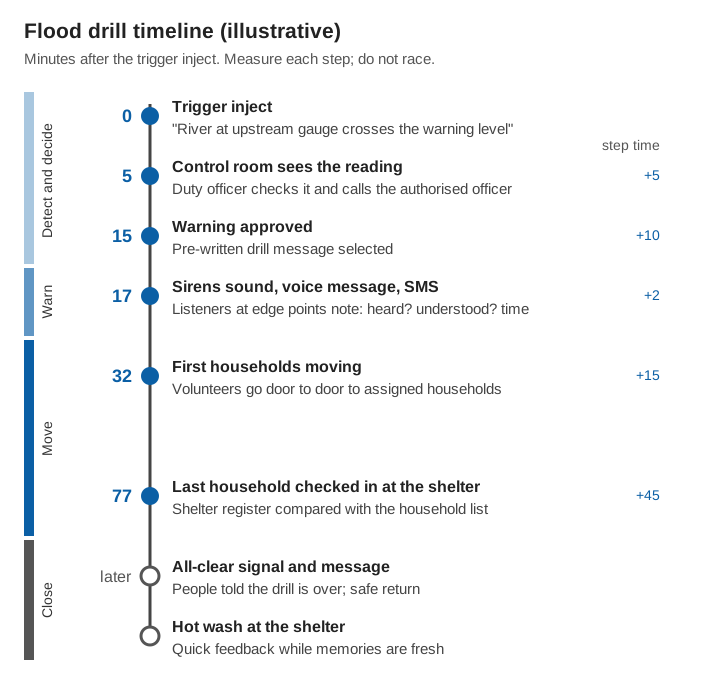
An illustrative example, with the arithmetic shown:
Trigger to control room noticing     5 min
Checking and approval               10 min
Approval to sirens sounding          2 min
Sirens to first household moving    15 min
-------------------------------------------
Trigger to first movement           5 + 10 + 2 + 15 = 32 min
First movement to last at shelter   45 min
Trigger to everyone at shelter      32 + 45 = 77 min
Compare that total with the time the river allows. If a flood takes about an hour to travel from the upstream gauge to the village, a 77-minute chain is too slow, however good each step looks on its own. The time available depends on the catchment; flash floods vs river floods explains why. Here the gains lie in the 15 minutes before anyone moves and the 45 minutes to finish: better buddy lists, closer shelters, clearer messages. Measure, but do not race; participants must not be hurried [1].
Observers and evaluation
NDMA advises choosing evaluators from outside the organisation being tested, briefing them on the tasks for each objective, and giving them pre-formatted forms that record whether each task was done and how long it took [1]. Tell participants that the exercise tests plans, not people, and that no individual will be named. Straight after the drill, hold a "hot wash", a quick round of impressions while memories are fresh, then a fuller debrief in which participants speak before the evaluators give their assessment [1].
Goa's 2023 state cyclone exercise shows the shape. It began at 09:00 with a review by video call. At 09:20 the Water Resources Department sounded the sirens on the early warning dissemination towers, and 91 people were evacuated by alternative routes. Observers from the NDRF, armed forces, Coast Guard and police watched each site, and a debriefing with the lead observers followed [4].
What goes in a flood mock drill report?
A flood mock drill report is the formal record of the exercise and its lessons. NDMA says it must cover the type, scope and objectives; participants; planning and preparation; the scenario and injects; conduct; feedback from observers and participants; the evaluators' assessment; whether each objective was met and why not; lessons learnt; and recommendations [1]. For a siren drill, add the coverage forms, the step timings and the shelter register count against the household list. Circulate the draft to participating organisations for comment before it is final [1].
The report then becomes an improvement action plan with named responsibilities and deadlines, reviewed periodically and checked again before the next exercise [1]. After an earthquake exercise in November 2022, Assam's recommendations included permanent police radio detachments at district emergency operation centres, more satellite phones, and HAM radio training for staff and volunteers [5]. A drill whose findings are still open next year has not done its job.
Key points
- A flood mock drill rehearses one task, such as warning and evacuating a village, for real; hold one at least yearly, before the monsoon.
- Build up from orientation and tabletop exercises to village drills and district mock exercises.
- Set a few measurable objectives, timed injects, clear roles and safety, and tell the public before any siren sounds.
- Publish what each siren sound means, including the all-clear; check coverage at the edges and the buddy list for people who cannot hear.
- Time every link from trigger to the last household at the shelter and compare it with the time the river allows.
- Turn the report into an action plan with owners and deadlines.
Where ClimMaTech fits
At ClimMaTech we build river monitoring stations and community sirens that form part of the warning chain a drill tests; our flood warning page shows how they fit together. Rakshak is a multi-hazard early warning siren with a built-in library of 15–20 user-selectable siren tones and voice messages. Flood warning is its lead use, and the same siren can sound alerts for other disasters and civil defence (air-raid) warnings and broadcast voice announcements, which helps a district keep each signal distinct during a drill.
References
- National Disaster Management Authority, Guidelines on Disaster Management Exercises (DMEx), Government of India, New Delhi, October 2024. ndma.gov.in (PDF)
- World Meteorological Organization, Multi-hazard Early Warning Systems: A Checklist, outcome of the first Multi-hazard Early Warning Conference, Cancún, WMO, Geneva, 2018. globalplatform.undrr.org
- International Federation of Red Cross and Red Crescent Societies, Community early warning systems: guiding principles, IFRC, Geneva, 2012. ifrc.org
- Department of Information and Publicity, Government of Goa, State Level Mock Exercise on Cyclones Held, press release, 5 March 2023. dip.goa.gov.in
- Assam State Disaster Management Authority with NDMA, Programmatic report on multi state mock exercise in Assam (exercise of 9–17 November 2022), ASDMA, Guwahati. asdma.assam.gov.in
- The Sentinel, Assam: NDMA-ASDMA conducted flood mock exercise in State, Guwahati, 20 December 2024. sentinelassam.com