
Writing warning messages people act on
What a flood warning message must say, in what order, and the common wording mistakes that make people wait instead of move.

A river gauge crosses its danger level at night. The control room sends a text: "Water level at station X above DL. Be alert." Hundreds of people receive it. Most of them do nothing, because the message never told them what to do, where, or by when. The sensor worked, the network worked, and the warning still failed at the last step: the words. A flood warning message is useful only if the person reading it can decide, in a few seconds, whether it concerns them and what to do next. This article explains what an early warning message should contain, how to order it, and how to check it before it is sent.
What should a flood warning message say?
A flood warning message should say five things: who is warning, what is happening, where, by when, and what the reader should do. Research on emergency warnings groups these as source, hazard or consequence, location, time and guidance, and finds that each is linked to people taking protective action [3]. The United States National Institute of Standards and Technology (NIST) reviewed this evidence for short messages and describes the same five types of information, citing earlier work that includes Mileti and Sorensen's 1990 review of more than 200 warning studies [1][3].
The World Meteorological Organization (WMO) gives a similar structure for forecasters, the "5W" format: who, what, when, where, and why or possible impacts. Its guidance asks that information be clearly written for the target audience, clearly highlighted in terms of impact, and specific about timing and location [2]. The "why" part is where a technical statement becomes a recommendation: the WMO's examples include a call to action such as "Turn Around Don't Drown" [2].
The five parts, in a short example, look like this:
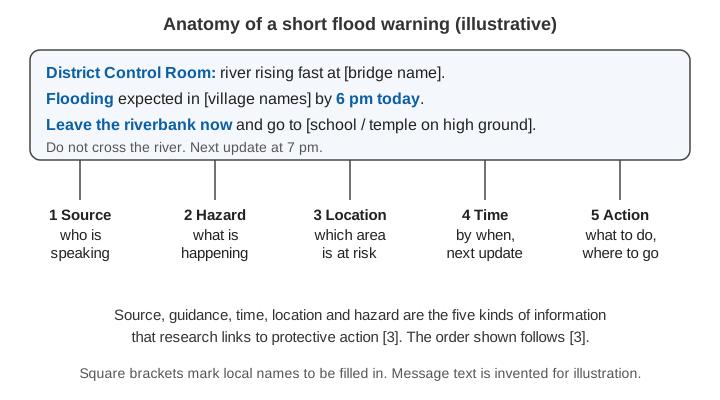
In what order should the information go?
Put the source first, then the hazard, the location, the timing and finally the guidance. NIST's review reports that the source should open the message and be named in full, because people judge credibility from it, and that for longer messages (280 characters in the studies it reviews) the order that raised credibility was hazard, location, timeline and then guidance [3]. It also reports that credibility rises when the source is one people see as knowledgeable about that hazard [3].
Two cautions apply. First, these studies were mostly done with mobile alerts and social media in the United States, so the exact ordering is evidence to test locally, not a rule of nature. Second, on a siren or a voice announcement the same elements apply, but the guidance usually comes earlier, because the listener cannot re-read the message.
On the technical side, the Common Alerting Protocol (CAP), the OASIS standard used by many national alert systems, keeps these parts in separate fields: a headline, a description of the hazard, an instruction to recipients, an area description and an expiry time. The CAP specification notes that a headline of about 160 characters is a useful target, and that short-message devices may show only that field, so it should be as direct and actionable as possible [4]. For how CAP is used in India, see cell broadcast alerts in India: SACHET and CAP explained.
How do you write an early warning message in plain language?
Write an early warning message in plain language by using short words, full names and exact times, and by avoiding abbreviations and gauge jargon. The NIST review found that readers often do not know abbreviations and acronyms, including time-zone codes and agency initials, and that this made short messages harder to understand. The research it reviews recommends removing abbreviations and jargon as far as possible, spelling out the source, and using clear language that leaves little room for interpretation [3].
A few rules follow directly for flood work in India:
- Replace gauge language with consequences. "Danger level crossed" is a technical state for hydrologists. "Water is entering low houses near the bridge" is something a villager can act on. For the difference between the two levels, see warning level vs danger level for river gauges.
- Name places people know. The NIST review notes that county names frustrated people who did not know the area, and that very large areas left readers unsure whether they were affected [3]. In a hill catchment, use village, ward, bridge, ghat, school or temple names, not block or tehsil names alone.
- Give a clock time, not "soon". The WMO notes that desired time detail should be agreed with users, for example "rain will begin at 4.00 a.m." rather than "early in the morning" [2]. "By 6 pm today" is better than "shortly".
- Say exactly where to go. NIST's review suggests going beyond "evacuate" to give routes or places, as in its example of moving a stated distance above the shoreline and inland [3]. For a flood in a hill valley, "go to the school on the upper road" does the same job.
- Do not hedge the instruction. If the hazard is uncertain, say so in the hazard part, and keep the action clear. The WMO warns that ambiguous wording can add more uncertainty than the forecast itself, and that "it is likely to be wet" and "it is unlikely to be dry" may provoke different responses [2].
- Do not rely on colour alone. The WMO notes that a warning colour with supporting text may suit the general public, but that the subtleties are lost if decisions rest purely on colour, so the "5W" content should be available to everyone, with detail below for specialist users [2]. For India's colour code, see India's colour-coded weather warnings explained.
Worked example: rewriting a weak message
The two messages below are invented for illustration. The first is typical of a message written from the sensor's point of view. The second is the same event written from the reader's point of view.
| Message | What is missing or wrong | |
|---|---|---|
| Weak | "WL at stn above DL. Be alert. Avoid river." | Abbreviations; no source; no place people know; no time; "be alert" is not an action; no next update |
| Better | "District Control Room: river rising fast at [bridge name]. Flooding expected in [village A, village B] by 6 pm today. Leave the riverbank now and go to [school on high ground]. Do not cross the river. Next update at 7 pm." | Source, hazard, location, time and guidance are all present, with a stated update time |
The better message is about 220 characters, longer than the headline target in CAP, so a team would normally keep it as the full text and use a shorter headline such as "Flood expected by 6 pm in [village A, village B]. Leave the riverbank now" for devices that show only a headline [4].
What about repeating a warning? Won't people ignore it?
The research does not support the fear that repeating a warning makes people ignore it. The abstract of Mileti and Sorensen's review lists the "cry wolf" syndrome and public panic among myths that are at odds with field findings, and names the warning source, consistency, credibility, accuracy, understandability and frequency among the factors that affect whether the public heeds a warning [1]. The same abstract challenges the "keep it simple" notion [1], which is why the guidance above asks for specific places and times rather than the shortest possible message.
Repetition helps only if the content is consistent. The WMO notes that messages often diverge or conflict over time without proactive communication management, and recommends one authoritative voice, with a formal list of persons authorised to communicate on every channel [2]. In practice, the siren, the text, the loudspeaker announcement and the app should carry the same hazard, place and time, even if the length differs. A siren cannot carry a long message, so use it for attention and pointers; see siren acoustics and coverage design and early warning dissemination: sirens, SMS and CAP.
Matching words to lead time
A message should also match the time available. The WMO describes content as a "trigger" followed by impacts and a suggested response, and lists action statements that range from "monitor" and "prepare" to "act now" and escape instructions [2]. A hill stream can rise within minutes, and then the message is "act now" with an escape place. A slow river flood allows an earlier "prepare" message, followed by a stronger one. For how fast different floods develop, see flash floods vs river floods: warning time.
A checklist before you send
Before any live alert goes out, read it once as someone who has never seen the gauge:
- Does it name the sender in full?
- Does it state the hazard in words, not gauge codes?
- Are the places ones the reader would recognise?
- Is there a clock time, and a time for the next update?
- Is there one clear action, and a place to go?
- Is it free of abbreviations and spelling errors?
- Is it the same in every channel, and in every language used in the area?
- Does it have an end: an all-clear or a message that cancels it?
Translation needs a person who knows both the language and the local place names. NIST's review notes that automatic translation can be inaccurate for emergency messages [3].
Key points
- A warning message must carry five things: source, hazard, location, time and guidance [3].
- Lead with the source, then hazard, location, time and action; test the order locally [3].
- Plain words, full names, exact times and named safe places beat abbreviations and gauge jargon [2][3].
- Research does not support the fear that repeated warnings make people ignore them; consistency and credibility matter, and conflicting messages do harm [1][2].
- Keep every channel consistent: the siren, text, voice message and app should say the same thing [2].
- Specific beats short: keep a brief headline for small screens, with the full text behind it [1][4].
Where this sits in the wider plan
The Early Warnings for All initiative, led by the United Nations with WMO and others, lists "warning dissemination and communication" as the third of the four pillars of multi-hazard early warning systems [5]. The message is the unit that this pillar delivers.
How this relates to our work
At ClimMaTech we build the sensing and warning devices that sit upstream of the message, and the message is where their readings become useful to people. Rakshak is a multi-hazard warning siren with a library of 15–20 user-selectable tones and voice messages, so a spoken instruction in the local language can follow the alert tone. Aagah is our public alert app, where the same five-part message can be shown as text. Live alerts need authorised approval, and the wording should be agreed with the district authorities in advance.
References
- D. S. Mileti, J. H. Sorensen, Communication of emergency public warnings: a social science perspective and state-of-the-art assessment, Oak Ridge National Laboratory report ORNL-6609, 1990. doi:10.2172/6137387
- World Meteorological Organization, WMO Guidelines on Multi-hazard Impact-based Forecast and Warning Services, Part II: Putting Multi-hazard IBFWS into Practice, WMO-No. 1150, 2021 edition. WMO page; PDF copy
- E. D. Kuligowski, J. Doermann, A Review of Public Response to Short Message Alerts under Imminent Threat, NIST Technical Note 1982, National Institute of Standards and Technology, 2018. doi:10.6028/NIST.TN.1982
- OASIS, Common Alerting Protocol Version 1.2, OASIS Standard, 1 July 2010. docs.oasis-open.org
- World Meteorological Organization, Overview of the Early Warnings for All: Executive Action Plan 2023–2027, WMO Bulletin 72(1), 2023. wmo.int