
Batteries in the cold: chemistry for Himalayan winters
Why lead-acid and lithium iron phosphate batteries lose capacity in the cold, why charging lithium below freezing does lasting damage, and how to design a battery box that gets a remote station through a Ladakh January.

A station in the high Himalaya can run happily from a solar panel and a battery for most of the year. Then winter arrives, and the battery that looked generously sized in October goes flat in January or, worse, keeps working while it quietly damages itself. This article explains what cold does inside lead-acid and lithium iron phosphate (LiFePO4) batteries, using published measurements, and turns that into design rules for the coldest weeks.
How cold a station battery really gets
The India Meteorological Department (IMD) climatological table for Leh, for 2011–2024, gives a mean daily minimum of −13.4 °C in January, −10.9 °C in December and −8.8 °C in February. Even the mean daily maximum in January is only 1.9 °C. In the ten Januaries from 2015 to 2024, the lowest temperature of the month ranged from −7.6 °C to −20.7 °C (3 January 2020), and the all-time January record is −28.3 °C [1].
A battery in a thin metal box will spend whole nights well below −10 °C. The coldest hour, just before sunrise, is also when the battery is at its lowest state of charge and the panel is about to start charging it. That combination matters for both chemistries. For the wider setting of stations in steep, cold catchments, see river monitoring in hill and Himalayan catchments.
Why cold reduces capacity and power
A battery works through reactions at the electrode surfaces and ions moving through the electrolyte. Cold slows both.
- Electrolyte transport. The electrolyte becomes more viscous and conducts ions less well. For lead-acid, measurements at the US Bureau of Standards showed that the fluidity (the inverse of viscosity) of sulphuric acid solutions of battery strength at −20 °C is only about a quarter of its value at 25 °C, and the authors attributed part of the loss of capacity at low temperature to this rise in viscosity [5]. For lithium-ion cells, reviews describe the same effect: viscosity rises and the conductivity of lithium ions falls [3].
- Charge-transfer kinetics. The reaction at the electrode surface (the charge-transfer step) slows down. In a study of LiFePO4 electrodes at low temperature, the authors identified sluggish charge transfer at the electrode–electrolyte interface and a dramatic fall in lithium diffusion inside the LiFePO4 particles as the key limiting factors [4].
- Internal resistance. Both effects appear to the user as a higher internal resistance, the resistance that makes the terminal voltage sag under load. A review of lithium-ion batteries at cold temperatures summarises that low temperature reduces the available energy and increases internal impedance [2].
The battery therefore reaches its cut-off voltage earlier, appearing "flat" while active material is still left inside. Much of that capacity returns when it warms, which is why a station that dies at dawn can recover by afternoon.
What the measurements show
The LiFePO4 electrodes delivered about 161.6 mAh/g at 20 °C, 141.4 mAh/g at −10 °C and 112.9 mAh/g at −20 °C [4]. The AGM battery, discharged at constant current, ran for 5.0 h at 25 °C, 3.25 h at −20 °C and 2.75 h at −40 °C [6]. Handbook data quoted in the same lead-acid study give 60 %, 50 %, 30 % and 15 % of the 25 °C capacity at −20, −30, −40 and −55 °C for a 20-hour discharge [6]. An IEA guide gives, as an example, only 60 % at −10 °C [10]. Numbers vary with battery and rate, but the message is consistent: at −20 °C, plan on roughly two-thirds of the rated capacity from either chemistry, and less from an old or partly charged battery.
Lead-acid: the electrolyte can freeze
In a lead-acid battery, sulphuric acid is consumed during discharge (it forms lead sulphate on both plates), so the electrolyte becomes weaker and closer to water as the battery empties. Weaker acid freezes at a higher temperature. Gandhi and colleagues note that a battery is typically charged with about 4.5 mol/L acid, which freezes at about −50 °C, but that during a discharge at −20 °C the electrolyte reaches its freezing point once the concentration falls to about 2.75 mol/L. They proposed freezing of the electrolyte as the major cause of the sharp drop in discharge time below 0 °C [6].
The practical form of this relation is a limit on depth of discharge, the fraction of capacity taken out. The IEA's recommended practices for charge controllers tabulate the deepest discharge that avoids freezing, for batteries with different full-charge and empty specific gravities (the density of the electrolyte relative to water) [9]. For a battery that reads 1.25 when full and 1.12 when empty:
| Battery temperature | Deepest discharge that avoids freezing |
|---|---|
| −10 °C | 100 % |
| −15 °C | 86 % |
| −20 °C | 69 % |
| −25 °C | 55 % |
| −30 °C | 42 % |
| −40 °C | 21 % |
Source: IEA PVPS T3-05:1998, Table 4 [9].
A frozen battery at best stops working until it thaws, and at worst the plates crack [9]. A flooded battery with stratified electrolyte (weak acid at the top, strong at the bottom) is more prone to freezing; a low-state-of-charge disconnect and an equalisation charge reduce the risk [10], and the winter load disconnect should be raised if the freezing limit is shallower than the normal disconnect point [9].
Lead-acid batteries also charge poorly in the cold and need a higher voltage to reach full charge, so a controller with fixed set points undercharges in winter and overcharges in summer. The IEA recommends temperature compensation for all but the smallest systems, with a sensor on the battery case or terminal, and gives the factor used by most controllers as −5 mV per °C per cell, or −30 mV per °C for a 12 V battery [9].
V_set(T) = V_set(25 °C) − 0.030 V/°C × (T − 25 °C)      (12 V battery)

Example: at T = −5 °C, the set point rises by 0.030 × 30 = 0.90 V
The IEA notes that the factor is certainly applicable from −5 °C to 35 °C, and that compensation must not push the voltage beyond what other equipment on the battery can tolerate [9].
Lithium iron phosphate: never charge it frozen
LiFePO4 has no aqueous acid to freeze and needs no watering, which makes it attractive for remote stations. Its weakness in the cold is not discharging. It is charging.
During charging, lithium ions leave the positive electrode and insert themselves (intercalate) into the graphite negative electrode. Lithium plating is a side reaction in which the ions instead deposit as metallic lithium on the graphite surface. It happens when the potential of the negative electrode approaches or falls below that of lithium metal, and it is aggravated by anything that slows intercalation, above all low temperature and high charging current [7]. A review lists severe plating and dendrite growth among the main problems below 0 °C [3].
What plating does:
- Permanent capacity loss. Plated lithium reacts with the electrolyte and is lost; even fairly uniform plating removes much more lithium than normal ageing [7].
- Higher resistance. A plated layer can block the active material behind it [7].
- Safety. Needle-like dendrites may pierce the separator and short the cell, and metallic lithium reacts exothermically with the electrolyte; cells aged at low temperature showed lower onset temperatures for thermal runaway than cells aged at high temperature [7].
The iron phosphate chemistry does not protect against this, because plating happens on the graphite negative electrode, which LiFePO4 cells share with other lithium-ion cells. Petzl, Kasper and Danzer cycled a commercial graphite/LiFePO4 cell at low temperature and high charge rate and found plating as a loss of cyclable lithium, together with a significant rise in the cell's ohmic resistance [8].
The temperature below which plating becomes likely depends on cell design, age and charging current, and plating can occur above 0 °C at high rates, which is why charge rates are kept low as temperature falls [7]. For a station, the safe rule is simple: no charging below about 0 °C battery temperature, and reduced current just above it, within the limits the cell maker states. Discharging below 0 °C is acceptable within the maker's stated discharge range, with the capacity loss shown above.
For lithium batteries in industrial and stationary use, the IEC safety standard is IEC 62619, Safety requirements for secondary lithium cells and batteries, for use in industrial applications [13].
Comparing the options
| Flooded lead-acid | AGM lead-acid (VRLA) | Gel lead-acid (VRLA) | LiFePO4 | |
|---|---|---|---|---|
| Discharge in the cold | Capacity falls; about 60 % at −20 °C in handbook data [6] | Similar; 65 % at −20 °C in a measured AGM test [6] | Same acid chemistry, same trend | Capacity falls; 70 % at −20 °C in a laboratory test [4] |
| Charging in the cold | Allowed, but needs temperature-compensated voltage [9] | Same; compensation especially important for sealed types [9] | Same as AGM | Must not charge below about 0 °C (lithium plating) [3][7][8] |
| Freezing risk | Electrolyte freezes when discharged; worse if stratified [9][10] | Freezes when discharged | Freezes when discharged | No aqueous electrolyte to freeze |
| Maintenance | Water top-up, venting of hydrogen, equalisation | Sealed | Sealed | Sealed; needs a battery management system with temperature cut-off |
| Main cold-weather control | Keep charged; raise winter load disconnect | Same | Same | Low-temperature charge cut-off and a heater |
VRLA means valve-regulated lead-acid, sealed batteries in which the electrolyte is held in an absorbent glass mat (AGM) or a silica gel.
The choice is not "lithium good, lead-acid bad". Lead-acid can be charged in the cold, with a compensated voltage, as long as it has not frozen, and keeping it well charged is also what protects it from freezing. LiFePO4 avoids the freezing problem altogether, but in a Ladakh winter it will only charge if something warms it first.
Designing the battery box
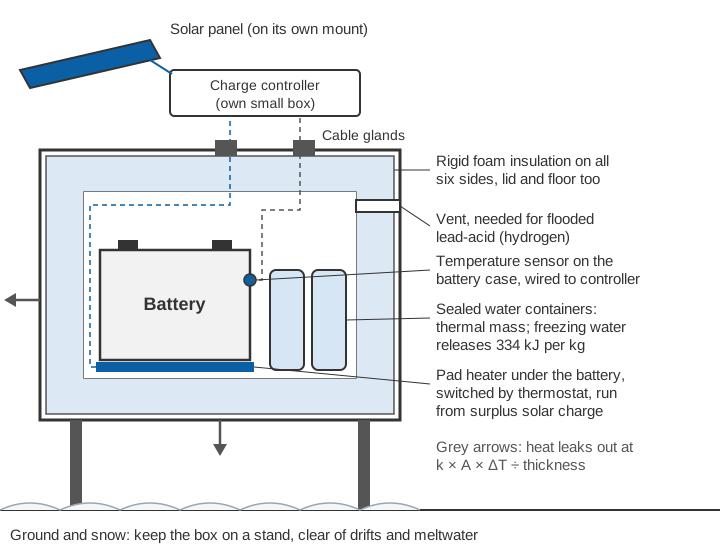
Insulation and thermal mass
Insulation only slows heat loss. Through a wall, heat flows at
P = k × A × ΔT / twhere k is the thermal conductivity of the insulation, A the area, ΔT the temperature difference and t the thickness. Expanded polystyrene samples measured in a recent study had k of about 0.040 W/(m·K), rising by about 5 % after 40 freeze–thaw cycles [12].
Worked example (illustrative). A box with 1.28 m² of wall area (0.6 × 0.4 × 0.4 m) is lined with 100 mm of polystyrene. Then k × A / t = 0.040 × 1.28 / 0.1 = 0.51 W per °C. Holding the inside at 0 °C with −15 °C outside, close to a January night in Leh, loses 0.51 × 15 ≈ 7.7 W. Over a 14-hour night that is about 108 Wh; with 50 mm of insulation it doubles.
Sealed water containers help. Water releases 334 J/g as it freezes [6], so 10 kg of water releases 3.34 MJ, or about 928 Wh, while staying at 0 °C. At 7.7 W that holds the box near 0 °C for about 120 hours. The IEA lead-acid guide reports that water-based phase-change containers have worked well [10]. A box at 0 °C protects lead-acid from freezing but is not warm enough to charge LiFePO4.
Heaters powered from the panel
For LiFePO4, put a thermostat-controlled pad heater under the battery (not on the water), powered when the panel produces more than the load needs, so the battery is above freezing before charge current is allowed. In the example box, holding +5 °C against −5 °C outside on a winter day costs about 0.51 × 10 ≈ 5 W, plus the energy to warm the battery itself.
A research alternative is a cell that heats itself. Wang and colleagues built a lithium-ion cell with a built-in heating element that warmed it from −20 °C to 0 °C within 20 seconds, using 3.8 % of its capacity [11]. Reviews describe preheating as a key cold-weather strategy, at the cost of extra energy [3][7].
Charge controller settings
- Lead-acid: temperature compensation, with the sensor on the battery, and a fall-back to safe 25 °C settings if the sensor fails [9]. Raise the winter load disconnect to stay above the freezing limit in the table.
- LiFePO4: a battery management system or controller that blocks charging below about 0 °C battery temperature and reduces current just above it, and a heater that runs before charging.
- Both: measure the battery's own temperature. The IEA notes that a controller's internal sensor can sit as much as 30 °C above ambient in some designs [9].
Siting and sizing
Keep the box on a stand clear of drifts and meltwater, and see the post-monsoon maintenance checklist for the autumn inspection that should precede every winter.
Worked example (illustrative). A station needs 30 Wh per day and four days of autonomy, so 120 Wh must be available on the coldest morning.
| Lead-acid | LiFePO4 | |
|---|---|---|
| Capacity available at −20 °C | 60 % (handbook data [6]) | 70 % (laboratory data [4]) |
| Usable depth of discharge | 60 % (load disconnect at 40 % state of charge, as the IEA recommends [9]; inside the 69 % freezing limit) | 80 % (an assumed design margin) |
| Nominal energy needed | 120 ÷ (0.60 × 0.60) ≈ 333 Wh | 120 ÷ (0.70 × 0.80) ≈ 214 Wh |
The same load sized for a warm site would need only 200 Wh of lead-acid or 150 Wh of LiFePO4. Winter adds roughly 40–70 % here, before any allowance for ageing or a panel buried in snow. The solar side needs the same winter-first thinking, set out in sizing solar power for an off-grid monitoring station.
Try it: temperature, capacity and charging
Key points
- At −20 °C, expect roughly two-thirds of rated capacity from lead-acid or LiFePO4; cold raises internal resistance through slower ion transport and charge transfer [2][4][5][6].
- Lead-acid electrolyte freezes when the battery is discharged: at −20 °C, a battery of specific gravity 1.25 when full should not be discharged deeper than about 69 % [6][9].
- Lead-acid needs temperature-compensated charging, about −30 mV per °C for a 12 V battery, with the sensor on the battery [9].
- LiFePO4 must not be charged below about 0 °C: lithium plating causes permanent capacity loss and raises safety risk [3][7][8].
- Insulation slows heat loss but does not stop it; thermal mass buys hours, and a solar-powered heater makes lithium chargeable in winter.
- Size the battery for the coldest week, not the annual average.
ClimMaTech builds monitoring stations for Himalayan rivers, where winter is the season that decides the battery design. Our RTDAS and hydromet telemetry page describes how these stations collect and send data from remote sites.
References
- India Meteorological Department, Leh: extreme weather events and climatological table, period 2011–2024, IMD Meteorological Centre, 2024. mausam.imd.gov.in
- J. Jaguemont, L. Boulon, Y. Dubé, A comprehensive review of lithium-ion batteries used in hybrid and electric vehicles at cold temperatures, Applied Energy 164 (2016), 99–114. doi:10.1016/j.apenergy.2015.11.034
- H. Luo, Y. Wang, Y.-H. Feng, X.-Y. Fan, X. Han, P.-F. Wang, Lithium-ion batteries under low-temperature environment: challenges and prospects, Materials 15 (2022), 8166. doi:10.3390/ma15228166
- J. Yao, F. Wu, B. Wu, X. Qiu, C. Yang, N. Li, Electrochemical performance and kinetics of LiFePO4/C cathode in a low-temperature electrolyte, World Electric Vehicle Journal 4(2) (2010), 396–399. doi:10.3390/wevj4020396
- G. W. Vinal, D. N. Craig, The viscosity of sulphuric-acid solutions used for battery electrolytes, Bureau of Standards Journal of Research 10 (1933), 781–793 (RP566). nvlpubs.nist.gov
- K. S. Gandhi, A. K. Shukla, S. K. Martha, S. A. Gaffoor, Simplified mathematical model for effects of freezing on the low-temperature performance of the lead-acid battery, Journal of the Electrochemical Society 156(3) (2009), A238–A245. doi:10.1149/1.3068391
- A. Tomaszewska et al., Lithium-ion battery fast charging: a review, eTransportation 1 (2019), 100011. doi:10.1016/j.etran.2019.100011
- M. Petzl, M. Kasper, M. A. Danzer, Lithium plating in a commercial lithium-ion battery – a low-temperature aging study, Journal of Power Sources 275 (2015), 799–807. doi:10.1016/j.jpowsour.2014.11.065
- E. P. Usher, M. M. D. Ross, Recommended practices for charge controllers, International Energy Agency, Photovoltaic Power Systems Programme, Report IEA PVPS T3-05:1998. iea-pvps.org
- International Energy Agency, Photovoltaic Power Systems Programme, Task III, Lead-acid battery guide for stand-alone photovoltaic systems, Report IEA-PVPS 3-06:1999. iea-pvps.org
- C.-Y. Wang, G. Zhang, S. Ge, T. Xu, Y. Ji, X.-G. Yang, Y. Leng, Lithium-ion battery structure that self-heats at low temperatures, Nature 529 (2016), 515–518. doi:10.1038/nature16502
- S. G. Petre, D. N. Isopescu, M. Pruteanu, A. Cojocaru, Effect of exposure to environmental cycling on the thermal conductivity of expanded polystyrene, Materials 15 (2022), 6921. doi:10.3390/ma15196921
- International Electrotechnical Commission, IEC 62619:2022 Secondary cells and batteries containing alkaline or other non-acid electrolytes – Safety requirements for secondary lithium cells and batteries, for use in industrial applications, edition 2.0, 2022. webstore.iec.ch