
The Dam Safety Act 2021: what it asks of dam owners and districts
A plain-language guide to which dams the Act covers, the four bodies it creates, what every dam owner must do and by when, and why district administrations are part of the picture.

Who must inspect a large dam, how often, and who must be told when the reservoir is about to release a flood? Since 30 December 2021 the answer has been in law. The Dam Safety Act, 2021 (Act No. 41 of 2021) sets out duties for owners of large dams, with deadlines and penalties, and gives district administrations and downstream communities a formal place in the chain of information.
This guide is for water resources engineers, disaster management officials and anyone who lives below a dam. Every point is taken from the Gazette text of the Act [1] or its regulations [2][3], with section numbers so you can check the original, as they stood in November 2025. It is an explanation, not legal advice: for a decision on a specific dam, read the Gazette text and consult the State Dam Safety Organisation or a lawyer.
The Act in one paragraph
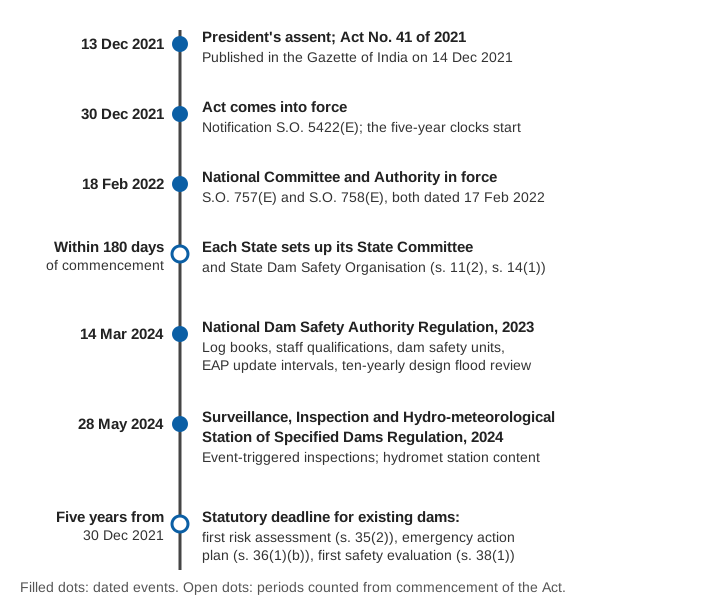
The Act received assent on 13 December 2021 and came into force on 30 December 2021 (notification S.O. 5422(E)) [1]. Its stated purpose is "to provide for surveillance, inspection, operation and maintenance of the specified dam for prevention of dam failure related disasters and to provide for institutional mechanism to ensure their safe functioning" [1]. It applies to the owner of every specified dam, public or private (section 3), and overrides anything inconsistent with it in other laws (section 48).
Which dams are covered: "specified dams"
The Act's duties apply to specified dams, defined in section 4(x). A dam (built before or after the Act) is a specified dam if it is:
- above 15 metres in height, measured from the lowest portion of the general foundation area to the top of the dam; or
- between 10 and 15 metres in height and meets at least one of these:
- crest length of at least 500 metres;
- reservoir capacity of at least one million cubic metres;
- maximum flood discharge dealt with by the dam of at least 2,000 m³/s;
- specially difficult foundation problems;
- unusual design.
Two details are easy to miss. Height is measured from the lowest point of the foundation, not the riverbed, so a dam that looks 12 m high from the bank may exceed 15 m. And section 4(e) includes barrages, weirs and similar water-impounding structures, while excluding canals, flood embankments, dikes and guide bunds. Owners of other dams must still take necessary safety measures (section 46). Try the definition below.
Four bodies, two levels
The Act creates two bodies at the national level and requires two in every State. Their functions are listed in three Schedules at the end of the Act.
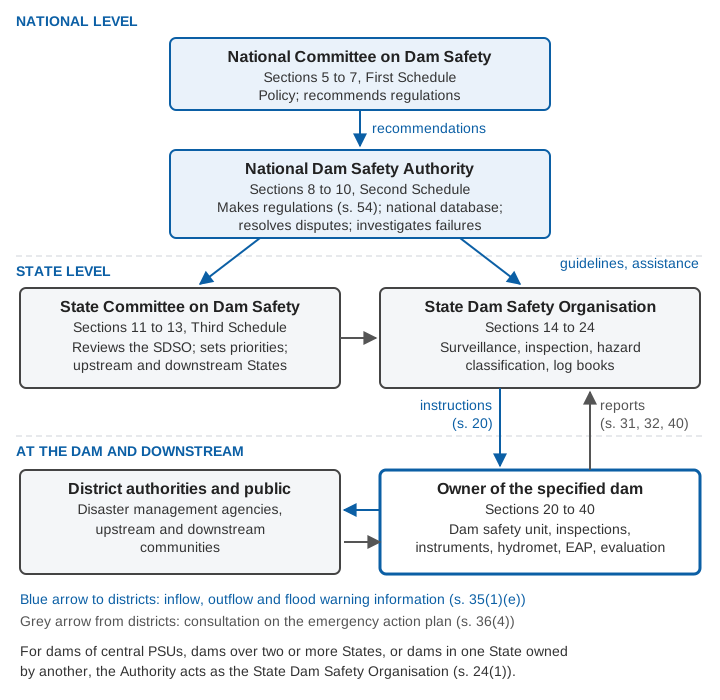
National Committee on Dam Safety (sections 5 to 7, First Schedule). Chaired by the Chairman of the Central Water Commission, with Central and State representatives and specialists (section 5(1)). It evolves policy, recommends regulations, analyses major incidents and failures, and advises on ageing dams and cascading reservoir operation. It must meet twice a year, once before the monsoon (section 7(1)). It came into force on 18 February 2022 (S.O. 757(E)) [1].
National Dam Safety Authority (sections 8 to 10, Second Schedule). Headed by an officer not below Additional Secretary rank (section 8(2)) and established by S.O. 758(E) from 18 February 2022 [1]. It implements the Committee's policies, makes regulations under section 54, keeps a national database of specified dams, lays down inspection guidelines and hazard classification criteria, accredits design and construction agencies, and investigates major failures. Item 28 of the Second Schedule tasks it with an early warning system for exchanging "real time hydrological and meteorological data and information related to operation of reservoirs". Its decisions are "final and binding upon all the parties" (section 9(3)).
State Committee on Dam Safety (sections 11 to 13, Third Schedule). Chaired by the State's Engineer-in-Chief for dam safety, with members from upstream and downstream States where a reservoir or its flood releases cross a State boundary (section 11(1)). It reviews the State Dam Safety Organisation, sets priorities for investigations and remedial works, and assesses the effect of a failure on downstream States and the chance of cascading failure. It also meets twice a year, once before the monsoon (section 13(1)).
State Dam Safety Organisation (SDSO) (sections 14 to 24). A separate organisation in the State department dealing with dam safety, headed by at least a Chief Engineer in States with more than thirty specified dams and at least a Superintending Engineer elsewhere (section 14(1)). It keeps "perpetual surveillance" of specified dams (section 16), classifies each by vulnerability and hazard (section 17), keeps a log book for each (section 18), and issues instructions on safety and remedial measures that owners must follow (section 20). Where a dam is owned by a central public sector undertaking, extends over two or more States, or lies in one State but is owned by another, the National Dam Safety Authority acts as its SDSO (section 24(1)).
Both State bodies had to be in place within 180 days of commencement (sections 11(2) and 14(1)).
What the owner of a specified dam must do
People and money. Every owner must post trained operation and maintenance staff at each dam and keep an operation and maintenance manual there, followed at all times (section 28), with a dam safety unit inside that establishment (section 30). The 2023 regulation scales the unit with the dam, from one headed by a Chief Engineer (60 m or higher, or 100 million m³ or more of storage) to one headed by an Assistant Engineer (10 to 15 m) [2]. Owners must earmark "sufficient and specific funds" for maintenance and repairs (section 21) and pay for investigations (section 25).
Inspections. Through its dam safety unit, the owner must carry out a pre-monsoon and a post-monsoon inspection every year (section 31(1)), plus inspections "during and after every flood, earthquake or any other natural or man-made calamities" or on any sign of distress (section 31(2)). The 2024 surveillance regulation makes the flood trigger specific: inspection during or after every 1-in-50-year flood for barrages and 1-in-100-year flood for dams, and immediately after an earthquake that causes structural damage, a glacial lake outburst flood, a landslide lake outburst flood or an avalanche [3]. Reports go to the SDSO for comment (section 31(3)(c)), and engineers must be stationed at the dam through the monsoon (section 31(3)(b)). CWC's inspection guidelines describe how inspections are done [4].
Instruments and data. Owners must keep a minimum set of performance instruments and send analyses of readings to the SDSO (section 32), and establish a hydro-meteorological station near each dam (section 33), and a seismological station for dams 30 m or higher or in seismic zones specified by regulation (section 34). The 2024 regulation lists what the hydro-meteorological station must measure: rainfall, water level, discharge, temperature, humidity, evaporation, wind speed and direction, and snowfall where applicable, at least once a day, at the dam site or within about 250 m of an abutment. It also requires discharge at the dam site to come from "a well calibrated rating curve which shall be updated every two years" [3]. (See our article on rating curves for why.) For the SDSO's log book of each dam (section 18), the 2023 regulation asks for reservoir level hourly in the monsoon and daily otherwise, and inflow and outflow daily, more often in the monsoon [2]. See reservoir level monitoring for how these readings are taken.
Forecasting and warning. Section 35(1) matters most downstream. Each owner must:
- establish a well-designed hydro-meteorological network and an inflow forecasting system (35(1)(a));
- establish an emergency flood warning system for the probable flood-affected areas downstream (35(1)(b));
- test both periodically (35(1)(c));
- give information on maximum anticipated inflows and outflows, including flood warnings and their likely impact, to the concerned district authorities and the public (35(1)(e)); and
- help the Authority run its early warning system for real-time hydro-meteorological and reservoir operation data (35(1)(f)).
Risk assessment, emergency action plan, evaluation. Owners must carry out risk assessment studies, the first within five years of commencement (section 35(2)); prepare an emergency action plan before first filling, or within five years for a dam already built and filled (section 36(1)); and commission a comprehensive dam safety evaluation by an independent panel of experts, the first within five years of commencement for existing dams (section 38(1)). It must review design floods and seismic safety (section 38(2)); the 2023 regulation requires the design flood review at least every ten years [2]. An evaluation is also compulsory after a major modification, the discovery of an unusual condition, or an extreme hydrological or seismic event (section 39).
Records. Owners must compile technical documentation, including land use downstream and what a failure would affect, and hold it in modern IT systems (section 22).
Duties at a glance
| Duty of the owner | Section | Frequency or deadline |
|---|---|---|
| Dam safety unit within the O&M establishment | 30; Reg. 6 of 2023 regulation [2] | Permanent; level set by dam height or storage |
| Pre- and post-monsoon inspection | 31(1) | Every year |
| Inspection after floods, earthquakes, calamities or distress | 31(2); Reg. 3(2) of 2024 regulation [3] | Each event, e.g. 1-in-100-year flood (dams), 1-in-50-year (barrages) |
| Engineers stationed at the dam | 31(3)(b) | Monsoon and emergencies |
| Instruments and analysis of readings to SDSO | 32 | Interval set by regulations |
| Hydro-meteorological station | 33; Reg. 4 of 2024 regulation [3] | Readings at least daily; rating curve updated every two years |
| Reservoir level for the SDSO's log book of the dam | 18; Reg. 3 of 2023 regulation [2] | Hourly in the monsoon, daily otherwise |
| Seismological station (dams 30 m or higher, or in specified zones) | 34 | Records micro and strong-motion earthquakes |
| Inflow forecasting and downstream flood warning | 35(1)(a) to (c) | Tested periodically |
| Inflow, outflow and warning information to districts and public | 35(1)(e) | No interval stated |
| First risk assessment study | 35(2) | Within five years of 30 Dec 2021 |
| Emergency action plan for an existing dam | 36(1)(b) | Within five years of 30 Dec 2021 |
| Emergency action plan for a new dam | 36(1)(a) | Before initial filling |
| Update contact details in the EAP | 36; Reg. 7 of 2023 regulation [2] | At least once a year |
| Table-top drill of the EAP | 36; Reg. 7 [2] | At least once in five years |
| Comprehensive review of the EAP | 36; Reg. 7 [2] | Every ten years |
| First comprehensive dam safety evaluation (existing dams) | 38(1) | Within five years of 30 Dec 2021 |
| Design flood review | 38(2)(b); Reg. 8 of 2023 regulation [2] | Every ten years or less |
| Evaluation after major modification, unusual condition or extreme event | 39 | Each occurrence |
| Report evaluation results to SDSO | 40(1) | After each evaluation |
What the Act means for districts and people downstream
The Act does not make the district responsible for the dam. It makes the district a participant and a recipient of information, which is where most of its value for downstream communities lies.
The emergency action plan is written with the district, not for it. Section 36(4) requires the owner, while preparing and updating the plan, to "undertake a consultation process with all disaster management agencies and other Departments of the State entrusted with disaster management and relief in the area likely to be affected and owners of other dams in the immediate vicinity". Under section 36(2) the plan must cover the likely emergencies, the flood from a failure with the areas, population and installations at risk, and "warning procedures, inundation maps and advance preparations". It is put into action whenever conditions are, or are likely to become, hazardous (section 36(3)).
The Central Water Commission's EAP guidelines call the district "the key level for disaster management and relief activities", with the Collector or District Magistrate as its focal point, and ask for alert levels that are the same in the dam's plan and the civil authorities' plan [5]. CWC's brochure summarises three: a blue internal alert (monitor and repair), an orange external alert (prepare to evacuate) and a red external alert (evacuate immediately) [6]. A plan not agreed with the district control room is of little use at 2 a.m. in a flood.
Information must flow to the district, and to the public. Section 35(1)(e) obliges the owner to give district authorities information on maximum anticipated inflows and outflows and flood warnings, and to put it in the public domain. A large controlled release can flood a valley without any failure, and this clause covers that case; see our article on spillways and gate operations. Note also that "dam failure" in section 4(f) includes faulty operation inconsistent with the operation and maintenance manual.
The safety status of dams is public. Each SDSO must send its annual report on the safety of specified dams to the State Disaster Management Authority and make it public; the Authority does the same with the National Disaster Management Authority (section 45(4) and (5)).
Everyone must help in an emergency. Every owner, organisation and authority under the Act must assist any authority dealing with a disaster arising from a specified dam (section 37).
In practice, a district with a specified dam upstream can reasonably ask the owner for the current EAP and its inundation maps, the date of the last contact update and table-top drill, and an agreed channel for inflow and release forecasts in the monsoon. Sirens, SMS alerts and community drills then build on that; see our article on warning dissemination.
Offences and penalties
Under section 41, anyone who without reasonable cause obstructs an officer or authorised person acting under the Act, or refuses to comply with a direction from the Central or State Government, the National Committee, the Authority, the State Committee or the SDSO, is punishable with imprisonment of up to one year, or a fine, or both. If the obstruction or refusal results in loss of life or imminent danger of it, the term may extend to two years.
If a government department offends, its head is deemed guilty unless he or she proves lack of knowledge or due diligence, and any other officer whose consent, connivance or neglect is proved is also liable (section 42). For companies, the persons in charge of the business are liable on the same terms (section 43). Courts act only on a complaint by a Government or a person authorised by one of the four bodies, before a Metropolitan Magistrate or Judicial Magistrate of the first class or higher (section 44).
Key points
- The Act covers specified dams: above 15 m from the lowest foundation, or 10 to 15 m with one of five further conditions (section 4(x)).
- The National Committee sets policy, the Authority makes regulations, the State Committee reviews and prioritises, and the SDSO inspects and instructs owners.
- Owners must run a dam safety unit, inspect before and after every monsoon and after major events, keep instruments and a hydro-meteorological station, forecast inflows and warn downstream areas.
- For existing dams, the first risk assessment, the EAP and the first comprehensive safety evaluation are due within five years of 30 December 2021. EAP contacts are updated yearly, drilled at least every five years and fully reviewed every ten.
- Districts must be consulted on the EAP and must receive inflow, outflow and warning information; dam safety reports are public.
Where ClimMaTech fits
At ClimMaTech we work on the monitoring and warning side of this picture: hydro-meteorological data around reservoirs and getting that information to the people downstream. Our dam and reservoir monitoring page describes this work. For the measurements behind it, see reservoir level monitoring and how spillways and gates work.
References
- Government of India, Ministry of Law and Justice (Legislative Department), The Dam Safety Act, 2021 (No. 41 of 2021), Gazette of India, Extraordinary, Part II, Section 1, No. 58, 14 December 2021; with Ministry of Jal Shakti notifications S.O. 5422(E) of 30 December 2021 (commencement), S.O. 757(E) and S.O. 758(E) of 17 February 2022 (National Committee and Authority). Compiled by the Central Water Commission. cwc.gov.in. Also on India Code: indiacode.nic.in.
- National Dam Safety Authority, National Dam Safety Authority Regulation, 2023, notification F. No. TE-32/2/2023-NDSA-MOWR dated 13 March 2024, Gazette of India, Extraordinary, Part III, Section 4, No. 173, 14 March 2024. Gazette copy, Irrigation Department, Uttarakhand.
- National Dam Safety Authority, Surveillance, Inspection and Hydro-meteorological Station of Specified Dams Regulation, 2024, notification F. No. TE-32/2/2023-NDSA-MOWR dated 20 May 2024, Gazette of India, Extraordinary, Part III, Section 4, No. 373, 28 May 2024. egazette.gov.in.
- Central Water Commission, Central Dam Safety Organisation, Guidelines for Safety Inspection of Dams, Doc. No. CDSO_GUD_DS_07_v1.0, January 2018. iitr.ac.in (copy).
- Central Water Commission, Dam Safety Organisation, Guidelines for Development and Implementation of Emergency Action Plan (EAP) for Dams, May 2006. cwc.gov.in.
- Central Water Commission, Emergency Action Planning for Dams (information brochure, Dam Rehabilitation and Improvement Project), 2016. cwc.gov.in.