
Types of emergency sirens: mechanical, electronic and voice
How motor-driven, electronic and voice-capable warning sirens make their sound, what the standard warning signals mean, and how a flood siren is set off.

A district office buying a siren for a flood-prone village soon meets a list of words: motor siren, electronic siren, voice siren, rotating, omnidirectional, wail, steady tone. This article explains the main types of emergency sirens, what the common warning signals mean, and how a flood siren is set off. How far a siren can be heard is covered in siren acoustics and coverage design.
How do warning sirens work?
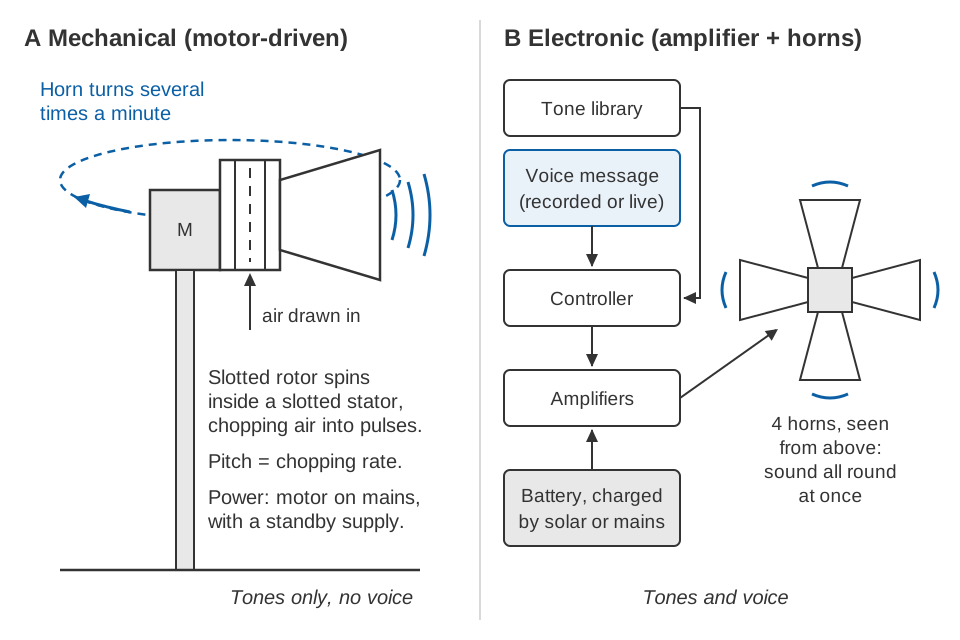
A warning siren makes a loud tone and focuses it into the horizontal plane, where people are [1]. There are two ways to make that tone. A mechanical siren chops a stream of air into rapid pulses. An electronic siren generates the tone as an electrical signal and plays it through amplifiers and horn loudspeakers [1][2]. A voice-capable siren is an electronic siren that can also play speech.
The basic frequency of almost every outdoor warning device lies between 300 and 1,000 Hz (cycles per second). Below that range, hearing is less sensitive and background noise is higher; above it, the air absorbs sound faster [1].
Mechanical (motor-driven) sirens
The classic air-raid siren is mechanical. A motor spins a slotted rotor inside a slotted stator (the fixed outer ring), chopping the airflow into rapid puffs that a horn shapes into a beam. The pitch (the frequency of the note) is set by how many times per second the airflow is chopped [1][2]. A "two-tone" siren chops the air at two rates at once and sounds two notes together [1].
Because pitch follows rotor speed, the note climbs as the motor speeds up and falls as it coasts down. Switching the motor on and off in a rhythm produces the rising and falling wail of an air-raid warning.
India's civil defence handbook lists three types of instrument for air-raid signals: steam sirens and whistles, power-driven rotary compressed-air sirens, and electrically driven rotary sirens [3]. FEMA's technical bulletin on outdoor warning systems calls mechanical sirens typically the most effective way to alert many people in the shortest time, and cost-effective in installation, reliability and maintenance [2]. But they produce only tones fixed by their design and cannot carry a voice message [2]. The handbook notes that a siren is normally connected to the mains and asks for a standby supply in case the mains fails [3]. India's specification for civil defence siren control equipment switches AC sirens through contactors (heavy-duty relays) [4].
Electronic sirens
An electronic siren works like a very loud public address system. A tone generator or a stored library of signals feeds amplifiers that drive loudspeaker units mounted on horns [2]. Nothing chops air, but it can imitate siren sounds and play many others: a slow wail, a fast warble, a steady tone or short blasts, changed on command.
The trade-offs are complexity and output. An electronic siren usually needs several amplifiers and other modules working in parallel to reach its rated sound, and its output is often lower than that of a large mechanical siren, so more units may be needed to cover the same area [1][2].
Power is the other big difference. An electronic siren can run from a battery charged by solar panels or the mains. As design guidance, FEMA's bulletin recommends stored energy for at least 24 hours on standby and at least 15 minutes at full output without recharging, even with a battery near the end of its life and in the worst expected temperatures [2]. Where the grid fails in the same storm that brings the flood, that independence from the mains matters.
Voice-capable sirens
A voice-capable siren is an electronic siren that also plays speech, either recorded messages or a live announcement from a control room [2]. This answers an old problem: a tone tells people that something is wrong, not what is wrong or what to do.
In their review of warning research for the Oak Ridge National Laboratory, Mileti and Sorensen found that people do not remember what different siren patterns mean, and rarely tell a wavering signal from short blasts. Sirens, they concluded, work best as an alert that sends people to look for more information [5]. A voice message gives that information on the spot.
FEMA's guidance for outdoor voice warning recommends [2]:
- a sequence of alert tone, then voice message, then end tone, so people notice the start and know when the message is over;
- pre-recorded or pre-scripted messages read by trained speakers;
- repeating the message in the languages that most listeners understand.
In India that often means the local language as well as Hindi or English, in short, plain sentences, for example (illustrative): "River rising fast. Move to the school on the hill now."
Voice has limits. A message may not be intelligible everywhere the siren is audible: echoes, and the same message arriving from two sirens at slightly different times, blur the words [1][2]. A network meant for speech may therefore need more, closer units than one that only sounds tones [2]. Writing the message itself is covered in early warning dissemination.
Omnidirectional, directional and rotating
FEMA describes three coverage patterns, used by both families [2]:
- Directional: one horn sends a focused cone of sound where it points.
- Rotating: the horn turns several times a minute, so the beam sweeps all round. To a listener standing still, the sound rises and falls in loudness as the beam passes [1][2].
- Omnidirectional: several horns point outwards from a centre and cover all directions at once.
An omnidirectional siren gives a steadier signal, which helps where background noise fluctuates; a rotating one, whose peak passes each listener only briefly, delivers a lower level over time. The cost is power: omnidirectional devices typically use more than rotating or directional ones of the same output [2]. In a narrow valley, horns pointed along the valley may put the sound where the houses are rather than into the hillside.
Mechanical, electronic and voice sirens compared
| Mechanical (motor-driven) | Electronic (tones only) | Electronic with voice | |
|---|---|---|---|
| How the sound is made | Rotor chops air; pitch follows motor speed [1][2] | Amplifiers drive horn loudspeakers [2] | As electronic, plus speech [2] |
| Sounds available | Fixed by design; wail made by speeding up and slowing down | Library of tones, changed on command | Tones plus recorded or live messages |
| Coverage pattern | Rotating horn, or non-directional [1] | Directional, multi-horn or omnidirectional arrays [2] | As electronic; speech may need closer spacing [2] |
| Power | Motor on mains, standby source needed [3] | Battery, charged by solar or mains [2] | As electronic |
| Tells people what to do | No | No | Yes |
| Upkeep | Motor and rotor; reliable and cost-effective [2] | More modules (amplifiers, drivers); battery replacement [2] | As electronic, plus keeping messages up to date |
What does a flood siren sound like?
There is no universal flood siren sound. Towns use their warning systems in different ways [1], and a flood siren sounds whatever signal its operator has chosen and publicised. The signals heard in Indian civil defence exercises are the air-raid signals set by the Directorate General of Civil Defence [3]:
- Action Warning (Red): a signal lasting 2 minutes, either a fluctuating or warbling note whose pitch swings at least 10 % above and below its mean, each rise and fall taking about 3 to 5 seconds, or a series of blasts of about 4 seconds separated by about 4 seconds of silence.
- Raiders Passed (Green): a continuous signal of 2 minutes at a steady pitch, the "all clear".
The specification for civil defence siren control equipment builds in the same pattern: 4 seconds on and 4 seconds off for 2 minutes as the warning, and a continuous 2-minute all-clear [4]. On a motor siren, that on-off switching produces the wail.
Elsewhere the same sounds mean different things. In the United States, FEMA's guide defines a 3 to 5 minute steady tone as the "Attention or Alert" signal for peacetime emergencies ("turn on radio or TV") and a 3 to 5 minute wavering tone as the attack warning [1]. A steady tone that means "all clear" in an Indian drill means "pay attention" there. If a district starts a flood warning with a steady tone, people who know the civil defence signals may relax at exactly the wrong moment.
So for a flood siren: do not reuse a signal that already means something else locally, use one signal across the district, announce it in advance, and add a voice message so that nobody has to remember a code.
ISO 7731, the international standard for auditory danger signals, sets design principles, ergonomic requirements and test methods for danger signals in public and work areas. It does not cover verbal warnings such as loudspeaker announcements (ISO 9921 does), and it states that special regulations for public disasters are not affected by it [6]. It is a reference for making a signal heard, not a flood code.
How do flood sirens work?
A flood siren is an outdoor siren placed where people are at risk from flooding and sounded on command when a flood threatens. It is the last link in a chain and does not itself decide that a flood is coming:
- Observation. River level gauges, rain gauges or forecasts show the river approaching a set threshold, such as the warning or danger level of a gauge (see warning level vs danger level).
- Decision. The alarm reaches a control centre, where an authorised person, with a second person's approval for a live public alert, decides to warn and chooses the area.
- Command. The control centre sends the command over a mobile, radio or satellite link to the sirens in that area.
- Sounding. Each siren plays the chosen tone and message and reports back that it did.
India's civil defence handbook takes the same line on authority: sirens are normally operated centrally from the town's control centre, and any local switch must be kept in a secure place to prevent unauthorised operation [3]. The control specification asks for safeguards against false sounding [4]. A false alarm costs the trust that makes people move when the real warning comes.
Sirens should also report their health (power, battery, charging, connectivity) so that a dead unit is found before the monsoon, and communities should rehearse the response: see running a community flood drill with sirens and the pre-monsoon readiness checklist. Routine siren testing is covered separately.
Key points
- Mechanical sirens chop air with a motor-driven rotor: loud and robust, tones only, mains power with a standby supply.
- Electronic sirens play stored tones through amplifiers and horns, can run from a solar-charged battery, and can add voice.
- Omnidirectional coverage is steadier than rotating but uses more power.
- India's civil defence warning is a 2-minute fluctuating note or 4-second blasts; the all-clear is a 2-minute steady note. In the United States, a steady tone means "alert".
- People forget siren codes: use a locally unambiguous tone followed by a voice message.
- Live flood alerts should be released by authorised people in a control centre.
Where ClimMaTech fits
RAKSHAK is our multi-hazard electronic warning siren, with a built-in library of 15–20 user-selectable siren tones covering the common warning signals, plus voice messages. Flood warning is its lead use, but it also serves any disaster, civil defence and air-raid warnings, and voice broadcasts. It sounds on an authorised alert command, and live alerts from the Rakshak Control Centre need authorised approval.
References
- Federal Emergency Management Agency, Outdoor Warning Systems Guide, CPG 1-17, FEMA, Washington DC, March 1980. web.archive.org copy of NC Department of Administration file (archived copy)
- Federal Emergency Management Agency, Nuclear and Chemical Hazards Branch, Outdoor Warning Systems Technical Bulletin, Version 2.0, Department of Homeland Security, 12 January 2006. web.archive.org copy of NC Department of Administration file (archived copy)
- Directorate General of Civil Defence, Ministry of Home Affairs, General Principles of Civil Defence in India, Part III "System of Air Raid Warning" and Appendix III-A "Public Warning Signals", New Delhi, 2003. dgfscdhg.gov.in
- Telecommunication Engineering Centre, Specification on Electronic Air Raid Precaution Equipment, No. NS5300C9302, New Delhi, October 1993. tec.gov.in
- D. S. Mileti and J. H. Sorensen, Communication of Emergency Public Warnings: A Social Science Perspective and State-of-the-Art Assessment, ORNL-6609, Oak Ridge National Laboratory, 1990, sections 3.1.3 and 3.6.1.8. UNT Digital Library
- International Organization for Standardization, ISO 7731:2003 Ergonomics — Danger signals for public and work areas — Auditory danger signals, 2nd edition, ISO, 2003 (confirmed 2022). iso.org