
Early Warnings for All and the Sendai Framework in India
What the UN Early Warnings for All initiative and the Sendai Framework for Disaster Risk Reduction ask of a country, and where India's own system already answers.

A district official reads that India is "committed to Early Warnings for All" and to "the Sendai Framework". The two phrases appear together in speeches and reports, and it is not obvious how they differ or what either one changes on the ground. In short, Early Warnings for All is a time-bound UN initiative to get warnings to everyone, and the Sendai Framework is the wider 15-year agreement on reducing disaster risk that gives that initiative its legal and policy home. This article explains both, sets out the four pillars of the initiative, and shows how India's existing arrangements line up with them.
What is the Sendai Framework for Disaster Risk Reduction?
The Sendai Framework for Disaster Risk Reduction 2015–2030 is the global agreement on reducing disaster losses. It was adopted at the Third UN World Conference in Sendai, Japan, on 18 March 2015, after consultations that began in 2012 [1]. It succeeded the Hyogo Framework for Action and runs to 2030.
The Framework has seven global targets and four priorities for action [1]:
- Priority 1: understanding disaster risk.
- Priority 2: strengthening disaster risk governance to manage disaster risk.
- Priority 3: investing in disaster risk reduction for resilience.
- Priority 4: enhancing disaster preparedness for effective response, and to "build back better" in recovery, rehabilitation and reconstruction.
Warnings sit in Target G: to "substantially increase the availability of and access to multi-hazard early warning systems and disaster risk information and assessments to people by 2030" [1]. A multi-hazard early warning system is one that handles several hazards (flood, cyclone, heat, landslide) through shared institutions and channels rather than one separate system per hazard. Priority 4, paragraph 33(b), tells states to invest in "people-centred multi-hazard, multisectoral forecasting and early warning systems", to develop them "through a participatory process", to "promote the application of simple and low-cost early warning equipment and facilities", and to "broaden release channels" [1].
Progress against the targets is tracked through national reporting against indicators. For Target G these include the number of countries with multi-hazard early warning systems, the number of people per 100,000 covered by early warning information, the percentage of local governments with a plan to act on warnings, and the share of exposed people protected by pre-emptive evacuation [2].
What is the Early Warnings for All initiative?
The Early Warnings for All initiative (EW4All) began with a speech. On World Meteorological Day, 23 March 2022, the UN Secretary-General announced that the World Meteorological Organization (WMO) would lead new action "to ensure every person on Earth is protected by early warning systems within five years". He noted that one in three people globally were still not covered [3]. The Executive Action Plan was launched in November 2022 at the UN climate conference in Egypt, with the aim of universal protection by the end of 2027 [4][5].
The plan is built on four pillars of an end-to-end, people-centred multi-hazard early warning system, each with a lead UN agency [4]:
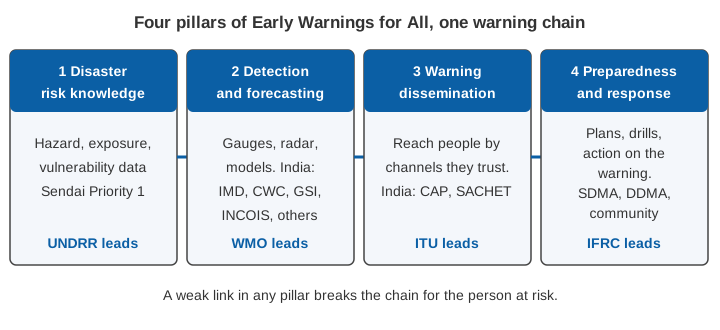
- Disaster risk knowledge, led by the UN Office for Disaster Risk Reduction (UNDRR).
- Detection, observation, monitoring, analysis and forecasting, led by WMO.
- Warning dissemination and communication, led by the International Telecommunication Union (ITU).
- Preparedness and response, led by the International Federation of Red Cross and Red Crescent Societies (IFRC).
The plan estimates that new targeted investment of US$ 3.1 billion is needed over five years: US$ 374 million for risk knowledge, US$ 1.19 billion for observations and forecasting, US$ 550 million for dissemination and US$ 1 billion for preparedness [4].
How are Early Warnings for All and Sendai related?
They are two layers of the same effort. The Sendai Framework is the long agreement with seven targets to 2030; EW4All is a five-year push to deliver one of them, Target G, faster and with money attached. The General Assembly's political declaration of May 2023, which concluded the midterm review of the Sendai Framework, said it was "deeply concerned that coverage of and accessibility to multi-hazard early warning systems remains inadequate in all countries". It welcomed the Secretary-General's call for universal coverage, "including through the Early Warning for All initiative" [8].
Each pillar also maps onto a Sendai priority. The mapping below is ours, offered as a reading aid; the documents do not tabulate it.
| EW4All pillar | Closest Sendai priority | What it asks in practice |
|---|---|---|
| 1. Disaster risk knowledge | Priority 1: understanding disaster risk | Hazard, exposure and vulnerability information that is current and shared |
| 2. Detection and forecasting | Priority 1 and Priority 4 (33b) | Monitoring networks and forecasts that run around the clock |
| 3. Warning dissemination | Priority 4 (33b: "broaden release channels") | Alerts that reach people by channels they trust |
| 4. Preparedness and response | Priorities 2 and 4 | Plans, roles and drills so that someone acts on the warning |
WMO reports that only about half of countries have adequate multi-hazard early warning systems, and that 38 % of its Members report legal arrangements to enable them [5]. A joint WMO–UNDRR report published in November 2024 found reported coverage at its highest level since 2015, but uneven. Countries with less comprehensive systems had a disaster mortality ratio nearly six times higher than those with substantial to comprehensive coverage [9].
What do they ask of India?
Both are frameworks for action and reporting, and India's own arrangements are set out in its National Disaster Management Plan (NDMP). What the two frameworks ask, in effect, is that those institutions can show results against Target G. The NDMP is the document that connects the two.
How does the NDMP line up with Sendai?
The NDMP of 2016 was, in the words of the 2019 revision, "the world's first ever national plan explicitly aligned with the Sendai Framework". The revised plan, issued by the National Disaster Management Authority (NDMA) in November 2019, runs its "long-term" period to 2030, the end year of the Sendai Framework, and reproduces the Target G indicators in an annexure [6]. So India's plan already uses Sendai's structure and reporting language.
Pillar 2 in India: who observes and forecasts
The NDMP names a central agency for each hazard. The India Meteorological Department (IMD) is responsible for cyclones, heat waves, cold waves and earthquakes; the Central Water Commission (CWC) for floods; the Geological Survey of India (GSI) for landslides; and the Indian National Centre for Ocean Information Services (INCOIS) for tsunamis [6]. These agencies "provide inputs to the MHA", the Ministry of Home Affairs, "which will issue alerts and warnings through various communication channels". They are also responsible for keeping their equipment working and for conducting drills [6]. For floods this means the CWC network of level and rainfall stations; our article on how a flood early warning system works shows where such stations sit in the chain.
The gap that EW4All highlights for pillar 2 is the density and reliability of observations, especially in small, fast catchments. A national station network that was designed for large rivers does not automatically see a Himalayan stream that rises in under an hour; see river monitoring in hill and Himalayan catchments and flash floods vs river floods for why.
Pillar 3 in India: reaching people
IMD and NDMA have built a Common Alerting Protocol (CAP) based system. CAP is an international message format that lets one warning be sent through many channels, such as SMS, cell broadcast, radio and television, without rewriting it each time. The Integrated Alert System, SACHET, developed by C-DOT on the CAP standard, covers all 36 states and union territories, and cell broadcast is being introduced for near real-time alerts to phones in affected areas [7]. The WMO article that reports this also notes that IMD issues cyclone warnings 5–7 days in advance since adopting CAP [7]. We explain the format and the channels in early warning dissemination: sirens, SMS and CAP and cell broadcast alerts in India.
Dissemination does not stop at a phone. The NDMP puts the last step on the state and district administrations, who "shall disseminate such alerts and warnings on the ground through all possible methods of communications and public announcements" [6]. Sendai asks for the same: tailored to users, "including social and cultural requirements" [1]. Language, literacy and disability are therefore part of the requirement, not extras (see warnings for everyone).
Pillars 1 and 4 in India: knowing the risk and acting on it
Pillar 1 depends on hazard maps, exposure data and vulnerability assessments at district and village level; how flood risk is assessed describes the method. Pillar 4 is where Sendai indicator G-4, the share of local governments with a plan to act on early warnings, applies directly [2]. The NDMP's response framework lists early warning, maps, satellite inputs and information dissemination among its response functions and names the early warning agencies as support agencies for them [6]. A warning that nobody has a plan for is the commonest failure here, which is why drills matter (see running a community flood drill with sirens).
How can a district or a project measure progress?
The Sendai indicators give a practical checklist, because they are written for local governments as well as countries [2]. A district disaster management authority can ask four plain questions:
- For which hazards do we have a monitoring and forecasting source we trust, and how many of our villages does it cover?
- How many people in the exposed areas would actually receive an alert, by which channel, and in which language?
- Does every block and panchayat in the exposed area have a written plan for what to do when the alert arrives?
- When did we last test the whole chain, from sensor to siren to evacuation?
The first three questions correspond to indicators G-2, G-3 and G-4; the fourth is the practical test behind G-6, the share of exposed people protected by pre-emptive evacuation [2].
Key points
- The Sendai Framework (adopted 18 March 2015) is the 2015–2030 global agreement on disaster risk reduction; Target G asks for more availability of, and access to, multi-hazard early warning systems and risk information by 2030.
- Early Warnings for All, launched in 2022 with a 2027 end date, is the UN push to deliver Target G, built on four pillars: risk knowledge, detection and forecasting, warning dissemination, and preparedness and response.
- India's NDMP, aligned with Sendai and revised in 2019, already assigns hazard-specific warning duties to IMD, CWC, GSI, INCOIS and others, and puts last-mile dissemination on state and district administrations.
- Progress is measured with Target G indicators, several of which a district can track locally.
- The weakest pillar sets the quality of the whole chain: a good forecast without a reachable, understandable alert and a ready community saves few lives.
Where ClimMaTech fits
At ClimMaTech we work mainly on pillars 2 to 4 at the local scale: river monitoring in the catchments that national networks see least, and community alerting at the point where a warning has to be heard. Our flood warning solution describes how monitoring, alert rules and dissemination connect, and Rakshak is our multi-hazard warning siren with 15-20 user-selectable siren tones and voice messages for the final step to the community.
References
- United Nations, Sendai Framework for Disaster Risk Reduction 2015–2030, UN Office for Disaster Risk Reduction (UNDRR), 2015. unisdr.org (PDF)
- National Disaster Management Authority, National Disaster Management Plan, 2019, Annexure III: Sendai Framework Indicators (Target G indicators G-1 to G-6), November 2019. ndma.gov.in (PDF)
- United Nations, UN weather agency to spearhead 5 year early warning plan, boosting climate action, UN News, 23 March 2022. news.un.org
- World Meteorological Organization, Overview of the Early Warnings for All: Executive Action Plan 2023–2027, WMO Bulletin 72(1), 2023. wmo.int
- World Meteorological Organization, WMO and the Early Warnings for All Initiative (programme page). wmo.int
- National Disaster Management Authority, Government of India, National Disaster Management Plan, revised edition, November 2019 (Chapter 3.2, Chapter 8.3, Table 8-1). ndma.gov.in (PDF)
- V. Gray, B. Hartley, E. Jones, J. Siegl, S. Nath, A. Robertson-Quimby, V. Vásquez, Leveraging the Common Alerting Protocol and Cell Broadcast Technology for Advancing Early Warnings for All, WMO Bulletin 74(2), 15 October 2025. wmo.int
- United Nations General Assembly, Political declaration of the high-level meeting on the midterm review of the Sendai Framework for Disaster Risk Reduction 2015–2030, resolution A/RES/77/289, adopted 18 May 2023, paragraphs 35–36. unfccc.int (PDF)
- World Meteorological Organization and UNDRR, Global Status of Multi-Hazard Early Warning Systems 2024, 13 November 2024. wmo.int