
Inclusive early warning systems: language and disability
A warning that only some people can hear, read or understand is not a warning for everyone: how to design alerts around language, literacy and disability.

A flood warning goes out at night. It is an SMS in English, followed by a siren. A man who is deaf never hears the siren. A woman who cannot read English cannot use the text. A boy who is blind gets the SMS but his phone is not set up to read it aloud. Each of them received the "warning", and none of them could act on it. Inclusive early warning systems start from this gap: a warning has done its job only when the person it is meant for can perceive it, understand it and act on it.
This article explains why the gap exists, what India's disaster management framework says about it, and how to design alerts so that more people are reached.
Why does an early warning system need to be inclusive?
An early warning system needs to be inclusive because hazards do not choose who is affected, while warning channels do. Every channel (siren, SMS, loudspeaker, television, mobile app) assumes some ability: hearing, sight, reading a particular language, owning a phone. Whoever lacks that ability is left out, and the people left out are often the ones who most need more time to move.
Evidence on this is consistent. A 2013 survey by the UN disaster risk reduction office of 5,717 persons with disabilities in 137 countries, quoted in India's National Disaster Management Plan, found that 72.9 % had no personal preparedness plan, and that only about 20 % could evacuate immediately without difficulty in a sudden disaster [1]. The same plan notes that persons with disabilities are "often overlooked and thus not only excluded in risk reduction and disaster response measures but are also subject to higher risk than others" [1].
What do the rules and frameworks say?
Three layers matter in India.
The international human rights treaty. Article 11 of the UN Convention on the Rights of Persons with Disabilities (CRPD) requires States Parties to "take … all necessary measures to ensure the protection and safety of persons with disabilities in situations of risk, including situations of armed conflict, humanitarian emergencies and the occurrence of natural disasters" [2]. India's National Disaster Management Plan, 2019 notes that Articles 11 and 32 of the Convention require persons with disabilities to benefit from and take part in disaster relief, emergency response and risk reduction [1].
The global initiative. The UN's Early Warnings for All initiative, announced by the Secretary-General in 2022, aims for everyone on Earth to be protected by early warning systems by the end of 2027. It is organised in four pillars: disaster risk knowledge, detection and forecasting, warning dissemination and communication, and preparedness and response [3]. The third pillar is where this article sits: getting the message to every person in a form they can use.
India's national plan and guidelines. The National Disaster Management Plan assigns designated agencies to monitor hazards and issue warnings, and requires State governments and district administrations to disseminate alerts "through all possible methods of communications and public announcements" [1]. It also records that the National Disaster Management Authority (NDMA) issued separate guidelines on disability-inclusive disaster risk reduction in 2019, which it says "must be consulted" [1]. The plan adds practical measures: district plans should keep lists of persons with disabilities who need special care, and neighbours can be trained as "buddies" who assist a named person [1].
How many people are we talking about?
Census 2011 counted 2.68 crore persons with disabilities in India, 2.2 % of the population [1]. Hearing and seeing impairments each account for about 19 % of that group: 18.9 % and 18.8 % respectively, with speech impairments at 7.5 % [4]. These are the groups for which common warning channels fail most directly.
Illustrative arithmetic, using those census shares:
Persons with disabilities (Census 2011):     2.68 crore
Hearing impairment:  2.68 × 0.189  = 0.51 crore   (a siren alone fails them)
Seeing impairment:   2.68 × 0.188  = 0.50 crore   (a visual alert alone fails them)
Hearing + seeing:                    = about 1.0 crore people
The census counted a decade and a half before this article, relied on how households answered, and does not include temporary impairments, older people who hear less well, or people who cannot read. So treat roughly one crore as a floor for the people who cannot use a single-sense channel, not as an estimate of need. The NDMP also notes that about 69 % of persons with disabilities live in rural areas [1], where phone coverage, electricity and services are thinner.
Which barriers do warnings run into?
It helps to separate the barriers, because each has a different fix.
| Barrier | Who is affected | What fails | What helps |
|---|---|---|---|
| Hearing | Deaf and hard-of-hearing people, and anyone sleeping or in a noisy place | Sirens, loudspeakers, voice calls | Text, flashing light, vibration, sign-language video, a neighbour who checks in |
| Sight | Blind and low-vision people | SMS read on screen, colour maps, flashing signs | Voice messages, siren tones with spoken instructions, phone screen readers, tactile or audio cues |
| Language | Speakers of languages not used in the message | Any message in the wrong language | Local-language text and audio, simple words, the same wording on all channels |
| Literacy | People who cannot read, or read slowly | Long text, abbreviations, English alerts | Voice, pictograms, colour plus words, repeated oral announcements |
| Cognition | People with intellectual or psychosocial disability, and children | Complex or conflicting instructions | One short action per message, plain words, a trusted person to confirm |
| Mobility | People who cannot walk quickly or climb | Messages that say "go" without saying how | Early, specific warnings, assistance plans, transport for those who need it |
| Access | People without a phone, power or signal | Apps and SMS | Sirens, public address, door-to-door visits, community volunteers |
The table is a general summary of the barriers; the same person can face several at once.
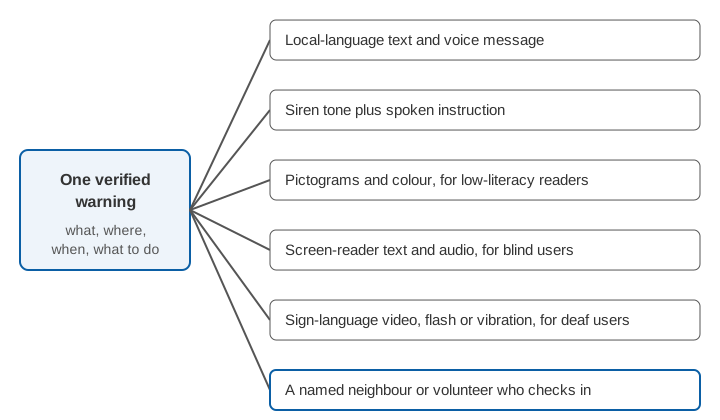
How do you design warnings that work across languages and literacy levels?
You design them in layers: one verified message, delivered in several languages and several forms, with the shortest possible wording.
Language. India's 2011 census grouped the mother tongues people reported into 121 languages, of which 22 are scheduled languages (those listed in the Eighth Schedule of the Constitution) [5]. No alert system will cover every one, so the practical rule is to cover the languages of the area where the warning will be received: the State language, the district's main languages and the dialects hill and tribal villages actually use. In the Common Alerting Protocol (CAP), the international message format used for public alerts, one alert can carry several <info> blocks, each tagged with its language, and an alert can reference an audio file [6]. That means one authorised message can be issued once and delivered in several languages. Where those translations come from, and who checks them, should be settled before the monsoon, not during it. For how CAP and cell broadcast work in India, see cell broadcast alerts in India.
Literacy. Text-only warnings assume that everyone can read them. Voice messages, repeated announcements and pictograms do not. Colour codes work only if the colour is explained and does not carry the meaning alone; the national colour scale is explained in India's colour-coded weather warnings.
Wording. Short sentences, plain words, one action per message and the same wording on every channel matter more than any technology. We cover this in writing warning messages people act on.
Testing. A message that is clear to the person who wrote it may not be clear to a farmer in the next valley. Test with people from the groups you are trying to reach, and run the drill with them in it; see running a community flood drill with sirens.
What about deaf and blind users in particular?
Researchers have studied this closely for deaf users. A 2018 paper in the International Journal of Mass Emergencies and Disasters argues that for people who are Deaf and rely on sign language as their first language, captions and SMS or email text in a written language are not always accessible, because the written language may be a second language for them. The authors conclude that text alone as the sole means of communication is not entirely accessible [7]. A longitudinal study of the deaf community in New South Wales, Australia, found that limited and uneven access to information in accessible formats, along with governance structures that often exclude d/Deaf people, held back their ability to respond to hazards, and that the biggest obstacles to lasting improvement were a lack of sustained funding and clear directives [8].
Some Indian practice is moving in this direction. The Kerala State Disaster Management Authority states that it disseminates early warning messages in sign language and audio format for persons with disabilities through its Facebook page [9]. That is one channel, and not everyone uses social media, but it shows that accessible versions can be produced by a State authority as part of routine messaging.
For blind and low-vision people, the main points are plain: do not rely on the screen, give audio and voice, and make sure the apps used for alerts work with the phone's built-in screen reader. For sirens, the lesson is that a tone says "danger" but not "which way to go", so a spoken instruction after the tone makes the message usable by people who cannot see signs or maps. The acoustics and siren types are covered in types of warning sirens and siren acoustics and coverage design.
A checklist for an inclusive warning plan
- Know who is in the area. Use a district or village register of people who need extra help, kept with their consent and updated every season [1].
- Use at least two senses. Sound and light, voice and text, so that no one channel is the only route.
- Issue the same message in the area's languages. Settle translation and approval before the season.
- Name a person. A buddy or volunteer for each person who may not receive the alert is the last link that technology cannot replace [1].
- Plan for the next step. A warning to someone who cannot walk fast is useful only if help and transport are arranged.
- Rehearse with the people concerned. Include persons with disabilities in drills and in the design review, not only in the audience.
Key points
- A warning is inclusive only when everyone it is meant for can perceive, understand and act on it, whatever their language, literacy or disability.
- CRPD Article 11 requires measures to protect persons with disabilities in disasters, and India's National Disaster Management Plan 2019 points to NDMA's disability-inclusive guidelines [1][2].
- Census 2011 counted 2.68 crore persons with disabilities; about 19 % have hearing impairments and about 19 % seeing impairments, so any single-sense channel leaves out around a crore people [1][4].
- Use several channels and forms, one verified message in the area's languages, short plain wording and a named person for those who may not get the alert.
- Test the system with the people it is meant to protect.
Where ClimMaTech fits
Our work on warning dissemination treats the siren as one layer among several. Rakshak is a multi-hazard warning siren with a library of 15–20 user-selectable tones and voice messages, which lets an authority pair a tone with a spoken instruction in the local language; because sound reaches only people who can hear it, it works best alongside visual, text and person-to-person channels. Aagah is our public alert app for people with a phone, and the place where text versions of a warning belong in this layered approach.
References
- National Disaster Management Authority, Ministry of Home Affairs, National Disaster Management Plan, November 2019, sections 4.6 and 8.3 (Persons with Disabilities; National Early Warning System). PDF
- United Nations, Convention on the Rights of Persons with Disabilities, Article 11: Situations of risk and humanitarian emergencies, UN Department of Economic and Social Affairs. un.org
- United Nations, Early Warnings for All. un.org
- Office of the Registrar General and Census Commissioner, India, Measurement of Disability through Census: National Experiences, India, presentation to the UN Expert Group Meeting on disability measurement, 12–14 July 2017 (Census 2011 table C-20). unstats.un.org
- Office of the Registrar General and Census Commissioner, India, Census of India 2011: Language Atlas, India, Ministry of Home Affairs, 2022 (Annexure II: family-wise grouping of the 121 scheduled and non-scheduled languages). censusindia.gov.in
- OASIS, Common Alerting Protocol Version 1.2, OASIS Standard, 2010, sections 1.3.2, 3.2.2 and 3.2.3. docs.oasis-open.org
- D. Bennett, S. LaForce, C. Touzet, K. Chiodo, American sign language and emergency alerts: the relationship between language, disability, and accessible emergency messaging, International Journal of Mass Emergencies and Disasters 36(1), 71–87, 2018. doi:10.1177/028072701803600104
- E. Calgaro, N. Craig, L. Craig, D. Dominey-Howes, J. Allen, Silent no more: identifying and breaking through the barriers that d/Deaf people face in responding to hazards and disasters, International Journal of Disaster Risk Reduction 57, 102156, 2021. doi:10.1016/j.ijdrr.2021.102156
- Kerala State Disaster Management Authority, Disability & Disaster Risk Reduction. sdma.kerala.gov.in