Open channel flow meter types: contact vs non-contact
How the main open channel flow meters work, what each needs to touch, and when staying out of the water is worth the trade-offs.

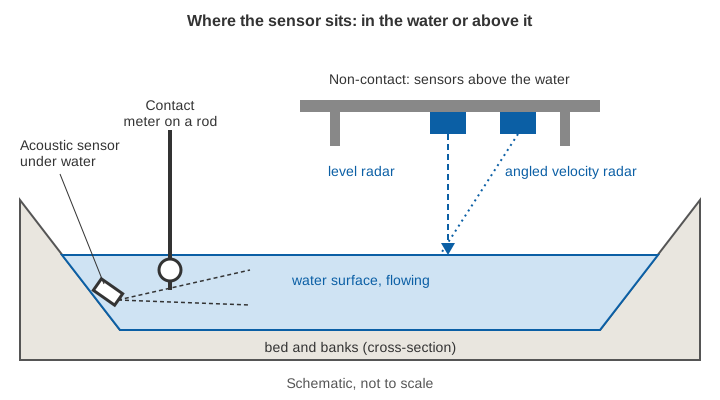
A river is rising, the gauging team is on the bank, and the question is whether anyone can safely put an instrument in the water. Behind it sits a wider one: which of the many open channel flow meter types should a station, a canal or a field team actually use? Nearly all of them measure the same thing, the discharge (volume of water passing a section each second, in m³/s), but they differ in what they touch, what they assume and when they fail. This article sorts them by one practical line: does the sensor sit in the water, or above it?
How does an open channel flow meter work?
An open channel flow meter does not measure discharge directly. It measures one or two simpler quantities and combines them with the geometry of the channel. There are three families:
- Head-discharge: a structure such as a weir or flume forces the flow through a known control, so one water-level reading gives discharge. We cover these in how to measure canal discharge.
- Velocity-area: the section is divided into panels, the velocity in each is measured, and discharge is the sum of velocity × area over the panels. This is the principle behind current meters, acoustic profilers and radar.
- Stage-discharge (rating): a water-level sensor plus a rating curve built from earlier velocity-area gaugings.
So the real distinction between meter types is how they obtain velocity and level. The WMO Manual on Stream Gauging describes the velocity-area principle as the basis of conventional current-meter, moving-boat acoustic and many other methods [1].
Contact flow meters: sensors in the water
A contact meter has some part in the flow. These are the long-established methods, and they remain the reference against which others are checked.
Current meters
A current meter is an instrument calibrated to measure the velocity of flowing water at a point. The WMO manual lists four kinds: rotating-element mechanical meters, electromagnetic meters, acoustic meters and optical meters, and notes that all of them, when properly maintained and calibrated, are considered suitable and accurate for measuring streamflow velocity [1]. A mechanical meter relies on the proportionality between water velocity and the angular velocity of its rotor. An electromagnetic meter uses Faraday's law: water, a conductor, moving through a magnetic field produces a voltage proportional to its speed [1]. An acoustic Doppler velocimeter (ADV) measures point velocity from the Doppler shift of sound scattered by particles in the water [1].
The method is described in ISO 748:2021, which covers rotating-element meters, ADVs, the stationary ADCP method and surface-velocity methods such as floats [2]. We walk through the field procedure in the velocity-area method.
Worked example (illustrative). An 8 m wide section is divided into four panels of 2 m, each with a measured depth and mean velocity:
| Panel | Width (m) | Depth (m) | Mean velocity (m/s) | Area (m²) | Discharge (m³/s) |
|---|---|---|---|---|---|
| 1 | 2 | 0.6 | 0.35 | 1.2 | 0.42 |
| 2 | 2 | 1.1 | 0.80 | 2.2 | 1.76 |
| 3 | 2 | 1.3 | 0.95 | 2.6 | 2.47 |
| 4 | 2 | 0.7 | 0.40 | 1.4 | 0.56 |
| Total | 7.4 | 5.21 |
The section discharge is 0.42 + 1.76 + 2.47 + 0.56 = 5.21 m³/s, giving a mean velocity of 5.21 / 7.4 ≈ 0.70 m/s.
The limits are practical, not theoretical. Someone must stand in or above the water, and every gauging is a single visit. The WMO manual makes safety a primary consideration for any field measurement [1], and floods are exactly when the data matter most.
Acoustic Doppler current profilers (ADCP)
An ADCP sends sound pulses along several beams and measures the Doppler shift of the echoes from particles suspended in the water, giving a velocity profile through the depth. Mounted on a boat, it records velocity, depth and boat position while crossing the river, and the same velocity-area sum gives discharge [1][3]. The WMO manual notes that ADCPs mounted on tethered boats allow measurements from a bridge or cableway where launching a manned boat is difficult [1].
The USGS guidance on ADCPs from a moving boat is explicit about the conditions that spoil a measurement [3]:
- Too little or too much sediment. Pure water is acoustically transparent, so very clear streams may return too little signal; high sediment concentrations can attenuate the signal or confuse bed detection [3].
- Moving bed. Sediment moving along the bed biases the bottom-tracking boat velocity, so measured velocities and discharges are biased low [3].
- Unmeasured zones. An ADCP cannot measure at the water surface (because of instrument draft and blanking distance) or near the bed (side-lobe interference); those layers are estimated [3].
The authors add that an ADCP "is only accurate when used with appropriate techniques" [3]. Fixed acoustic meters (ADVMs, and path-based ultrasonic meters) are installed on a bank or bed and give an index velocity, used with a calibration to the mean velocity in the section; the WMO manual notes their value in backwater, slow and tidal reaches [1].
Structures
Weirs and flumes are also contact methods in the sense that they are built into the channel. They give discharge from a single level reading, but need head loss and a clean approach, as we explain in the canal discharge article.
What does non-contact flow measurement mean?
Non-contact flow measurement means that no part of the instrument is in the water. Sensors are mounted on a bridge, cable-stay or pole and look at the surface from above. Two measurements are needed, and each has its own sensor.
Level from above. A radar level sensor sends radio waves to the water surface and times the echo. The WMO manual describes radar water-level sensing as generally immune to weather conditions, and notes that radar gauges are often affected by waves on the surface [1]. Ultrasonic sensors work the same way with sound, but the manual points out that the sound signal is affected by air temperature and density, especially over distances of more than about 3 m [1]. We compare them in radar vs ultrasonic, float and pressure sensors and explain radar in radar water level sensing.
Velocity from above. A Doppler radar aimed at the surface receives echoes from the small ripples on it. The motion of those ripples shifts the frequency of the reflected waves, and the shift gives the surface velocity [1][4]. Our article on surface velocity radar explains the physics. The WMO manual states the condition plainly: "some water surface roughness must be present", generated by turbulent boils, wind or rain [1]. A mirror-smooth surface returns no usable echo.
Surface velocity is not mean velocity. The WMO manual says a coefficient is needed to convert surface velocity into mean velocity, and that an assumption about the shape of the velocity profile is required [1]. In experiments on two US rivers, mean velocity was approximately 0.85 times the measured surface velocity [4]. A field assessment of portable surface velocity radars confirmed 0.85 as a valid default, but preferred a site-specific calibration, to avoid underestimating discharge in very smooth channels and overestimating it in very rough ones [5].
Worked example (illustrative). Take the 7.4 m² section from above and a cross-section-average surface velocity of 0.83 m/s:
Q = A × k × v_surface
k = 0.80:  Q = 7.4 × 0.80 × 0.83 = 4.91 m³/s   (-6 %)
k = 0.85:  Q = 7.4 × 0.85 × 0.83 = 5.22 m³/s
k = 0.90:  Q = 7.4 × 0.90 × 0.83 = 5.53 m³/s   (+6 %)
A change of 0.05 in the coefficient moves discharge by about 6 %. This is why the coefficient is the part of non-contact measurement that needs checking against gaugings.
How accurate is non-contact discharge?
The evidence is encouraging but not unconditional:
- In experiments on the San Joaquin and Cowlitz rivers, non-contact radar discharges were within a few percent of gauging-station, current-meter and hydroacoustic values, and within 5 % of the rated discharge in a flood. On the San Joaquin, however, the radar discharge was more than 20 % higher than independent measurements in the first days, before agreeing within 5% [4].
- Portable radars gave discharge estimates within 10 % for low and intermediate relative roughness when the velocity coefficient was theoretical or site-calibrated [5].
- At 10 USGS streamgages, fixed radars were compared with conventional measurements over extended periods, with surface velocities of 0.30 to 3.84 m/s, and were found to be highly correlated with conventional methods [6].
The WMO manual cautions that non-contact methods "show great promise, but there is still much to be learned": water conductivity and depth limit how far radar energy penetrates water, and the surface-to-mean assumption remains [1].
Contact vs non-contact: a side-by-side comparison
| Current meter | ADCP / fixed acoustic | Weir or flume | Non-contact radar | |
|---|---|---|---|---|
| In the water? | Yes | Yes (transducers) | Structure in channel | No |
| What is measured | Point velocity, depth | Velocity profile, depth | Upstream head | Level and surface velocity |
| Needs people in or over water | Yes | Yes for boat gaugings | No | No, after installation |
| Continuous record | No, one visit | Fixed units: yes | Yes | Yes |
| Main weakness | Safety in floods, one visit at a time | Sediment, moving bed, unmeasured layers [3] | Head loss, silt | Needs rippled surface; velocity coefficient [1][5] |
| Reference role | Reference for others | Used as a reference where a boat or tether is possible | Direct for small flows | Calibrated against gaugings |
How to choose
- To calibrate or check anything: a current-meter or ADCP gauging by a trained team remains the reference.
- For a small, controlled channel with a drop available: a measuring structure.
- For a river or canal where nothing can be built and floods make contact hazardous: non-contact radar, calibrated at the site, with periodic checks of the surveyed cross-section.
- For backwater or tidal sites: fixed acoustic index-velocity meters have an established record [1], and non-contact methods should be proven locally before relying on them.
In Himalayan streams, where floods carry boulders and debris, equipment in the channel is at risk exactly when the data matter most; see river monitoring in hill and Himalayan catchments. That is a reason to consider non-contact options, not a reason to skip calibration.
Key points
- Open channel flow meters measure level, velocity or both, and combine them with channel geometry to give discharge.
- Contact meters (current meters, ADCPs, fixed acoustic meters) are well established but put people or equipment in the flow.
- Non-contact radar measures level and surface velocity from above and needs a rippled surface and a surface-to-mean velocity coefficient.
- ADCP errors come mainly from sediment, a moving bed and unmeasured layers; radar errors from the coefficient and the surface condition.
- Whatever the meter, gauge it against an independent measurement from time to time.
Where ClimMaTech fits
At ClimMaTech we build non-contact river monitoring for sites where instruments in the water do not survive floods. PRAVAAH combines an AWLR (Automatic Water Level Recorder) with an SVR (Surface Velocity Radar) in one non-contact unit, and DoorDrishti adds an AI camera to the same radar.
References
- World Meteorological Organization, Manual on Stream Gauging, Volume I: Fieldwork, WMO-No. 1044, 2010 (chapters 4, 5, 6 and 8). PDF
- International Organization for Standardization, ISO 748:2021, Hydrometry — Measurement of liquid flow in open channels — Velocity area methods using point velocity measurements, 5th edition, 2021. iso.org
- D. S. Mueller, C. R. Wagner, M. S. Rehmel, K. A. Oberg, F. Rainville, Measuring discharge with acoustic Doppler current profilers from a moving boat, U.S. Geological Survey Techniques and Methods 3-A22, version 2.0, 2013. doi:10.3133/tm3A22
- J. E. Costa, R. T. Cheng, F. P. Haeni, N. Melcher, K. R. Spicer, E. Hayes, W. Plant, K. Hayes, C. Teague, D. Barrick, Use of radars to monitor stream discharge by noncontact methods, Water Resources Research 42(7), 2006. doi:10.1029/2005WR004430
- M. Welber, J. Le Coz, J. B. Laronne, G. Zolezzi, D. Zamler, G. Dramais, A. Hauet, M. Salvaro, Field assessment of noncontact stream gauging using portable surface velocity radars (SVR), Water Resources Research 52(2), 1108–1126, 2016. doi:10.1002/2015WR017906
- J. W. Fulton et al., Near-field remote sensing of surface velocity and river discharge using radars and the probability concept at 10 U.S. Geological Survey streamgages, Remote Sensing 12(8), 1296, 2020. doi:10.3390/rs12081296