
Dam water release alerts: warning people downstream
What a dam water release does to the river below, what Indian law and CWC guidance ask of dam owners, and how a warning chain should work before the gates open.

A river below a dam can look calm on a sunny day, and then rise by a metre within the hour because gates were opened somewhere upstream. People walking on the dry riverbed, grazing animals or washing clothes have no way to know. This is why every dam water release needs a warning that reaches the people downstream before the water does. This article explains what a release does to the river, what the law and Central Water Commission (CWC) guidance ask of dam owners, and how a warning chain is built.
Why does a dam water release endanger people downstream?
A dam water release endangers people because it turns a slow, stored volume into a fast flow in a channel that people use at low water. Below many dams, and especially below hydropower dams, the river is nearly dry or very low for much of the day. The riverbed becomes a place to walk, fish, graze animals and wash clothes. When gates open, the discharge can rise from a trickle to hundreds of cubic metres per second, and the front of the rise travels down the valley as a flood wave. A flood wave moves faster than the water in it [7], so it can arrive before anyone notices the river changing.
Three kinds of release need warnings:
- Planned releases: gates are opened to keep the reservoir below a target level, to pass inflow during the monsoon, or to flush silt.
- Operational changes: a hydropower plant cuts generation, or a unit trips, and the water that would have gone through the turbines goes over the spillway.
- Emergency releases: the inflow exceeds what the reservoir can hold, or a safety problem at the dam forces water out quickly.
The first two are predictable, which is exactly why they can be warned well. Our post on how dam spillways and gates work explains the gate side, and reservoir level monitoring explains why the operator needs live level and inflow data to decide when to release.
What does the Dam Safety Act 2021 require?
The Dam Safety Act 2021 makes downstream warning a legal duty of the dam owner. The Act came into force on 30 December 2021 by a notification of the Central Government [1]. Chapter VIII, Emergency Action Plan and Disaster Management, says that every owner of a specified dam shall, among other things [1]:
- establish a well-designed hydro-meteorological network and an inflow forecasting system (section 35(1)(a));
- establish an emergency flood warning system for the probable flood affected areas downstream of the dam (section 35(1)(b));
- test the functioning of these systems periodically (section 35(1)(c));
- make available information on maximum anticipated inflows and outflows, including flood warning, to the concerned district authorities and also in the public domain (section 35(1)(e)).
Section 36 requires an emergency action plan (EAP): one prepared before the initial filling of a new reservoir, and, for existing dams, within five years of commencement, then updated at regular intervals. The plan must include the types of emergencies likely in operating the reservoir, identification of the areas, population and structures likely to be affected by water released from the reservoir, and "warning procedures, inundation maps and advance preparations" to avoid loss of life [1]. The owner must consult the disaster management agencies and other departments of the state while preparing it [1]. Our post on the Dam Safety Act 2021 covers the wider Act.
What do CWC emergency action plan guidelines say?
CWC's guidance describes who does what. The Central Dam Safety Organisation's 2016 explainer, prepared under the Dam Rehabilitation and Improvement Project (DRIP), says that dam owners identify the emergency and send initial notifications to disaster management agencies, while local disaster management authorities issue the public warning and decide on any evacuation [3]. A basic EAP includes a map of the potential inundation area, "resulting from a dam breach or large controlled releases", and procedures for warning downstream authorities [3]. The same document notes that an EAP is needed for "large water releases during extreme weather conditions" as well as for dam failure [3].
The earlier CWC guidelines of May 2006 add practical detail [2]:
- A notification flowchart shows who calls whom, in what order, and who is authorised to do so. The dam owner is responsible for notifying local officials.
- The EAP should spell out procedures for opening spillway gates, "especially if a certain sequence is required".
- The engineer in charge should "inform immediately" the flood-fighting centre and the engineer downstream about releases from the reservoir.
- Inundation maps should show estimated flood travel time and depth at selected locations. The maps carry a note that the limits of flooding and the wave travel times are approximate and should be used as a guideline for evacuation zones [2].
- The alert levels run from an internal alert (monitor and repair) to an external alert: orange (prepare to evacuate) and red (evacuate immediately) [2][3].
A point worth noticing is the split of roles. The operator knows when the water will come; the district authority knows the people, roads and languages. A good release alert needs both, and a pre-agreed chain between them.
How do dam release alerts reach people?
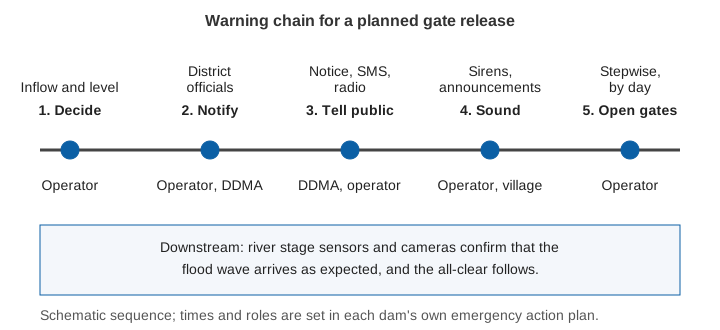
A release alert works when several channels carry the same message and it reaches people at the riverbank, not only in offices. The usual channels are:
- Notice to the district administration and disaster management authority, ahead of time, with the expected discharge and timing.
- Public notices, SMS, radio and social media. For how cell broadcast and the Common Alerting Protocol (CAP) fit in, see cell broadcast alerts in India. For wording, see writing warning messages people act on.
- Vehicle announcements and local volunteers for villages and for people on the riverbank who may not look at a phone.
- Sirens and hooters along the river, which work without a network and reach people who cannot read. Coverage depends on terrain and bends; see siren acoustics and coverage design.
What happened at Pong Dam in August 2025
A report in The Tribune describes the pattern in Himachal Pradesh. On 6 August 2025 the Bhakra Beas Management Board (BBMB) began a controlled release of 20,000 cusecs at Pong Dam in Kangra after the reservoir reached 1,372 ft, against a danger level of 1,390 ft. The Board issued a public notice the day before, its vehicles made public announcements, and early warning sirens were sounded ahead of the release. Kangra and Hoshiarpur districts were put on high alert [5]. Several channels were used together, which is the point.
What happens when the chain fails
In Himachal Pradesh, on the evening of 8 June 2014, 24 engineering students were swept away in the Beas at Thalot, in Mandi district, after a release of water upstream. The inquiry by the Divisional Commissioner of Mandi recommended, among other measures, a standard operating procedure for the release of dam water [6]. The lesson is general: a siren or hooter that the operator believes sounded, but that people on the riverbed did not hear, is not a warning.
In December 2021, Kerala's chief minister wrote to his Tamil Nadu counterpart that shutters of the Mullaperiyar dam had been opened at about 3 am without prior warning, and asked that releases be planned, gradual, and made only in daylight after proper warning to people downstream [4]. This is Kerala's account of that night; we cite it for the principle it states. Both cases point to the same three requirements: warn early, warn through more than one channel, and release gradually and, where possible, in daylight.
How much time does a warning have? A worked example
The time available is the time the flood wave needs to reach a place, which depends on distance and wave speed, plus whatever notice the operator gives before opening the gates. The CWC guidance asks for travel time on the inundation maps for this reason [2]. The wave speed is not the mean water velocity; it is usually larger [7], and is best estimated from upstream and downstream gauge records or from hydraulic routing, as our post on flash floods versus river floods explains.
Illustrative example. A village lies 24 km below a dam. Suppose gauge records show that a release wave travels at about 4 m/s along this reach (an assumed value):
Travel time = distance / wave speed
            = 24 000 m / 4 m/s
            = 6 000 s ≈ 100 minutes

If the public notice goes out 60 minutes before the gates open:
   village at 24 km:   60 + 100 = about 160 minutes of warning
   riverbank at 1 km:  the wave needs 1 000 / 4 = 250 s, about 4 minutes,
                       so the notice before opening is nearly all the time there is
People who live or work close to the dam have minutes, not hours, which is why sirens and announcements at the first kilometres matter most. A village 24 km away has more time, but only if someone tells it.
Why release gradually?
A gradual release gives people on the river time to leave, and keeps the rise slower. The chart below is illustrative: it compares opening all gates at once with raising the discharge in steps to the same final value.
A stepped release also lets downstream stage sensors show the wave arriving, so the operator can confirm that the rise matches the plan before opening more gates. This is also where measurement helps: river stage sensors and cameras downstream turn the release from an assumption into an observation. For how a downstream chain of sensors and warnings fits together, see how a flood early warning system works.
Key points
- A dam water release can raise a nearly dry river within the hour, so warnings must reach people at the riverbank.
- The Dam Safety Act 2021 requires owners of specified dams to establish a downstream emergency flood warning system, test it, and share outflow and warning information with district authorities and the public [1].
- CWC guidance splits the roles: the owner notifies, and local disaster management authorities warn the public and decide on evacuation [2][3].
- Travel time depends on distance and flood wave speed, not on mean water velocity; people near the dam have the least time.
- One channel is not enough, and a siren that was not heard is not a warning. Use notices, SMS, announcements and sirens together, and release in steps.
Where ClimMaTech fits
At ClimMaTech we work on the downstream end of this chain. Our dam and reservoir solutions page covers monitoring at dams and reservoirs, and downstream river level and flow measurement is what lets an operator confirm that a release is behaving as planned. Rakshak is a multi-hazard warning siren with a library of 15-20 user-selectable tones and voice messages, which can be used for flood warnings along a river and for other emergencies.
References
- Government of India, The Dam Safety Act, 2021 (No. 41 of 2021), Gazette of India Extraordinary, 14 December 2021, Chapter VIII (sections 35-37); commencement notification of 30 December 2021 printed in the same booklet. cwc.gov.in
- Central Water Commission, Dam Safety Organisation, Guidelines for Development and Implementation of Emergency Action Plan (EAP) for Dams, May 2006. cwc.gov.in
- Central Water Commission, Central Dam Safety Organisation, Emergency Action Planning for Dams, DRIP explainer, 2016. cwc.gov.in
- The Week, "Vijayan writes to Stalin after Mullaperiyar shutters opened without warning", 2 December 2021. theweek.in
- The Tribune, "Controlled water release from Pong Dam begins, alert sounded", updated 6 August 2025. tribuneindia.com
- The Tribune (Himachal pages), report on the Divisional Commissioner's inquiry into the Thalot accident on the Beas, 21 June 2014. tribuneindia.com
- V. T. Chow, D. R. Maidment and L. W. Mays, Applied Hydrology, McGraw-Hill, New York, 1988 (chapter 9, kinematic wave celerity: in a wide channel with Manning friction the wave travels at about 5/3 of the mean water velocity).