
How many automatic weather stations are there in India?
Who runs India's automatic weather stations and rain gauges, how many each operator reports, why published counts disagree, and where the data can be obtained.

Ask how many automatic weather stations there are in India and you will find a different answer in every news report: a thousand, two thousand, six thousand. None of them is necessarily wrong. India does not have one weather network but several, run by different agencies for different purposes, and each publishes its own count at its own date. Some counts include manually read rain gauges, some include agricultural stations, and some count stations that were planned or installed rather than ones that report today.
This article sets out what the operators themselves report: the India Meteorological Department (IMD), the Indian Space Research Organisation (ISRO), the Central Water Commission (CWC), the agencies of the National Hydrology Project and state governments. Every figure carries the date it applied and its source. We then explain why counts differ and where each network's data can be obtained.
Two terms first. An automatic weather station (AWS) measures several weather variables (typically temperature, humidity, pressure, wind and rainfall) and records and transmits them without an observer. An automatic rain gauge (ARG) measures rainfall only, also without an observer. How the instruments work is covered in our post on types of rain gauges used in India.
How many automatic weather stations are there in India?
In 2024 IMD alone operated 1,008 AWS, 200 Agro-AWS and 1,382 ARG stations, according to its Annual Report 2024 [1]. The same report lists five automatic snow gauges, 37 high wind speed recorders and 47 solar radiation stations [1]. IMD's Vision-2047 document, released in January 2025, gives the same AWS, Agro-AWS and ARG figures in its table of the surface network [2].
Agro-AWS are agricultural weather stations. IMD installed 200 of them at District Agromet Units on the premises of Krishi Vigyan Kendras (agricultural science centres of the Indian Council of Agricultural Research) during 2021–2022 [3]. Besides the standard sensors they measure soil moisture and soil temperature at four depths [1].
IMD is not the only operator. Its Annual Report 2016 noted that "other agencies have installed about 1200 AWS all over the country", in addition to IMD's own [4]. The largest single network outside IMD belongs to ISRO, described below. Adding IMD's 2024 count to that 2016 estimate gives more than 2,000 automatic weather stations before any later state network is added, though the two figures come from different years.
How the IMD network grew
IMD experimented with automatic data collection platforms from the 1980s, but the present AWS network grew from 125 stations installed in 2006–07 [2, 5]. In 2010 IMD engineers described a modernisation plan to reach "about 1100 AWS and 3600 ARGs across India" by 2012 [5]. The AWS figure passed that level by 2023 if Agro-AWS are included; the ARG figure did not come close. The ARG network has stayed close to 1,350–1,382 stations since 2014, while the AWS network grew [1, 6]. IMD's later work has gone into mesoscale networks of AWS and ARG in cities: in 2021–2022 it added 52 ARGs in Mumbai, Kolkata, Chennai, Pune, Guwahati, Agartala and Shillong [3], and on 15 January 2026 Union Minister Dr Jitendra Singh announced 50 more AWS each in Delhi, Mumbai, Chennai and Pune during 2026 [7].
ISRO's AWS network
ISRO has its own network, built mainly to supply surface data for numerical weather prediction. A 2014 paper by authors including scientists of ISRO's Space Applications Centre counted "about 1065 ISRO-AWS in India", with their locations published on the MOSDAC website [9]. ISRO's Weather and Climate page states that the data are used for "initializing numerical weather prediction as well as validating the forecasts" [10].
How many rain gauge stations are there in India?
India's largest rain gauge network is not an automatic one. It is IMD's District-wise Rainfall Monitoring Scheme (DRMS), which works with daily rainfall: the amount recorded at 08:30 IST, the total for the previous 24 hours [11]. The DRMS is the scheme behind the district, state and national rainfall figures IMD publishes every day [11, 12].
IMD started the DRMS in 1992 "initially using around 2,000 rain gauge stations". By July 2025 the network had "expanded to more than 6,700 rain gauges across the country", providing rainfall statistics for 738 districts [12]. In the same release IMD launched a Block-wise Rainfall Monitoring Scheme for about 7,200 administrative blocks [12].
The DRMS is largely a joint network. According to the Statistical Year Book India 2011, it comprised 2,821 selected stations: 411 IMD surface observatories, 232 IMD hydromet observatories and 2,178 rain gauge stations of state governments [11]. A short calculation shows how much depends on the states:
State gauges' share of DRMS stations = 2,178 ÷ 2,821 = 77 %
IMD's own share                             = (411 + 232) ÷ 2,821 = 23 %
The same source noted that rainfall was also recorded at 7,941 observatories maintained by state governments and other non-IMD agencies, and that in January 2006 IMD's own network consisted of 660 surface observatories and 697 hydromet observatories [11].
The rest of IMD's surface network
IMD still runs staffed observatories alongside its automatic stations. Vision-2047 lists 547 surface manual observatories and 223 agromet manual observatories [2]. IMD divides its surface observatories into classes by their instruments and observing schedule: Class I observatories have both eye-reading and self-recording instruments, Classes II and III mainly eye-reading instruments, and Classes IV to VI fewer instruments or non-instrumental observations [2].
Who runs India's weather stations and rain gauges?
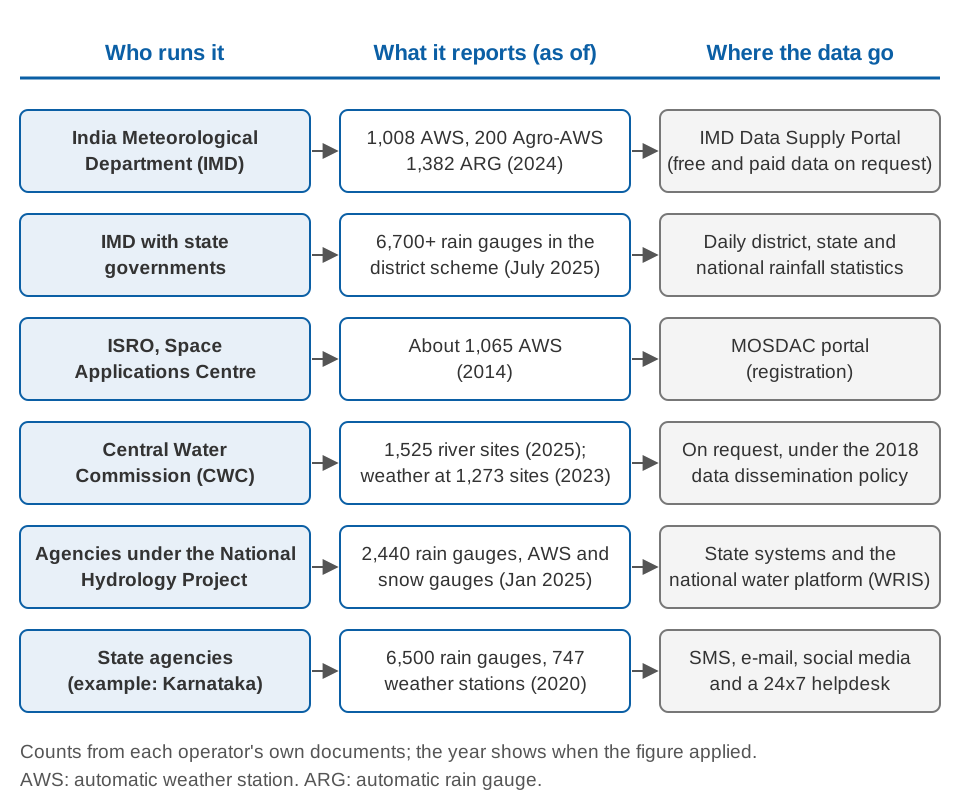
Beyond IMD and ISRO, three groups run large networks.
The Central Water Commission. CWC, under the Ministry of Jal Shakti, runs India's central river gauging network. As on 1 January 2025 it had 1,525 hydrological observation sites in operation, with 18 more under review, 1,543 in all [15]. Many of these also observe weather: CWC's 2023 station book lists meteorological observations at 1,273 locations, 1,192 of them at river stations and 81 exclusively meteorological; that edition lists only manually observed stations [16].
Agencies under the National Hydrology Project (NHP). The NHP, supported by the World Bank, funded real-time hydromet stations for central and state water agencies from 2017. By 31 January 2025, 12,540 water-resources monitoring stations operated by its implementing agencies were providing validated data online, of which 2,440 were meteorology stations (rain gauges, automatic weather stations and snow gauges) [17]. The count includes the real-time data acquisition systems (RTDAS) funded by the project [17]; our post on what an RTDAS is explains how they work.
State governments. Several states run their own dense networks for disaster management and agriculture. The best documented is Karnataka's. In 2020 the Karnataka State Natural Disaster Monitoring Centre (KSNDMC) reported 747 telemetric weather stations, one in every hobli (a revenue sub-division of a taluk), and 6,500 telemetric rain gauges, one in every gram panchayat, sending data every 15 minutes [18].
At the national level, the Ministry of Agriculture and Farmers Welfare launched the Weather Information Network Data Systems (WINDS) portal on 21 July 2023, with the stated target of "a wide network of weather stations at the block and gram panchayat level", so that farmers and decision makers get accurate weather data [19].
A table of the main networks
| Network | Operator | Type | Approximate count | Figure as of | Source |
|---|---|---|---|---|---|
| Automatic weather stations | IMD | Automatic | 1,008 | 2024 | [1] |
| Agro-AWS at Krishi Vigyan Kendras | IMD | Automatic, with soil sensors | 200 | 2024 | [1] |
| Automatic rain gauges | IMD | Automatic, rainfall only | 1,382 | 2024 | [1] |
| Surface manual observatories | IMD | Staffed | 547 | January 2025 | [2] |
| Agromet manual observatories | IMD | Staffed | 223 | 2024 | [1] |
| District-wise Rainfall Monitoring Scheme | IMD with state governments | Daily-read rain gauges | more than 6,700 | July 2025 | [12] |
| ISRO AWS | ISRO | Automatic | about 1,065 | 2014 | [9] |
| AWS of all agencies other than IMD | Various | Automatic | about 1,200 | 2016 | [4] |
| Hydrological observation sites | CWC | River gauging | 1,525 (1,543 with sites under review) | 1 January 2025 | [15] |
| Meteorological observations at CWC sites | CWC | Manual | 1,273 | 1 January 2023 | [16] |
| NHP meteorology stations | Central and state agencies | Rain gauges, AWS, snow gauges | 2,440 | 31 January 2025 | [17] |
| KSNDMC telemetric rain gauges | Government of Karnataka | Automatic, rainfall only | 6,500 | 2020 | [18] |
| KSNDMC telemetric weather stations | Government of Karnataka | Automatic | 747 | 2020 | [18] |
Do not add the column up. The networks overlap: IMD's own observatories are part of the DRMS [11], and a state agency's stations can appear both in its own list and in a national programme's count.
Why do the numbers in news reports differ?
Most disagreements come from five sources, and IMD's own documents show each of them.
- Automatic and manual are mixed. A count of "rain gauges" may mean IMD's 1,382 ARGs, the 6,700-plus DRMS gauges, or both. A count of "weather stations" may or may not include manual observatories.
- Agricultural stations are counted in or out. IMD's review of 2014–2023 lists 1,208 AWS in its table and 1,008 in its text [6]. The difference is the 200 Agro-AWS: 1,008 + 200 = 1,208. Neither number is wrong; they answer different questions.
- Different documents, different dates. Networks change continually, and documents are compiled at different times. Vision-2047 gives 6,095 DRMS stations in its network table and 6,495 in its section on rainfall monitoring; it gives 547 manual surface observatories in one chapter and "surface observations (560)" in another [2]. The figures come from different sections of the same document, so quote the one you use together with where it came from.
- Planned, installed, functional and reporting are different stages. A target becomes a contract, then installed stations, then stations that report, then stations whose data pass quality control. The 2012 target of 3,600 ARGs [5] was never a count of stations. In March 2025 the World Bank reported that, of 156,000 hydromet stations configured in the NHP's Water Information Management Systems, about 140,000 had started sharing data, and 41,000 provided real-time data [17]. A station on the first list is not necessarily on the third.
- Repeated text. Annual reports sometimes carry forward a paragraph from an earlier year. IMD's annual reports for 2016, 2020 and 2021 repeat the same sentence giving 682 IMD AWS and 1,350 ARGs [4, 13, 14], so the figure in a given report is not always a fresh count.
When you quote a number, quote its date, its source and what it counts. "IMD operated 1,008 AWS in 2024, plus 200 agricultural AWS" is a fact; "India has 1,208 weather stations" is not.
Who can get the data?
Access differs by network. What follows is what each operator documents.
- IMD. Historical observations are supplied through IMD's Data Supply Portal, run by the National Data Centre in Pune since 1 March 2019 [20]. Users register, check what data exist and see an estimate of the charges; some data series are free [20]. In 2023, 1,448 new users registered on the portal and IMD received 3,015 data requests [8]. IMD's real-time AWS/ARG website used to be open to the public; Down To Earth reported in October 2025 that IMD had restricted it around May 2025, and that in replies to Right to Information requests IMD said access had been "restricted to designated users" and pointed users to the Data Supply Portal [21].
- DRMS rainfall. IMD publishes daily, weekly, monthly and seasonal rainfall statistics for districts, states and the country [1, 12]. Our post on how IMD classifies monsoon rainfall explains how to read them.
- ISRO AWS. Station data are listed in the in-situ (AWS) catalogue of MOSDAC, the data portal of the Space Applications Centre [9, 22]. Its data access policy gives registered general users access with a latency of three days, registered privileged users near-real-time access to all data, and anonymous users metadata, images and open data [22].
- CWC. CWC disseminates its data under the Ministry of Jal Shakti's Hydro-meteorological Data Dissemination Policy, 2018 [15].
- NHP agencies. Station data from NHP-funded and other sources are being standardised and integrated with the national platform, 119,746 stations by January 2025; the project's public information system is the Water Resources Information System (WRIS) [17].
- State networks. KSNDMC disseminates forecasts, warnings and reports by e-mail, SMS and social media and through a round-the-clock helpdesk, Varuna Mitra, for farmers [18]. Other state agencies have their own arrangements.
How dense is the network, and what comes next?
IMD itself says more stations are needed. Its Vision-2047 lists, among gaps in surface observation, a need for AWS at block level (6,612), ARGs at panchayat level (250,000), and 10,000 district rainfall monitoring stations "to have sufficient spatial coverage" [2]. How to work out the density a district actually needs is the subject of our post on rain gauge density. More stations also mean more to maintain; see the total cost of a monitoring network.
Key points
- IMD operated 1,008 AWS, 200 Agro-AWS and 1,382 automatic rain gauges in 2024 [1].
- ISRO counted about 1,065 AWS in 2014 [9]; IMD reported about 1,200 AWS run by other agencies in 2016 [4].
- IMD's district rainfall scheme used more than 6,700 rain gauges by July 2025; it works with daily rainfall, and many of its gauges belong to state governments [11, 12].
- CWC ran 1,525 river observation sites on 1 January 2025 [15]; NHP agencies had 2,440 meteorology stations online by 31 January 2025 [17]; Karnataka alone had 6,500 telemetric rain gauges in 2020 [18].
- Counts differ because they mix manual and automatic stations, include or exclude agricultural stations, come from different dates, and count planned, installed or reporting stations.
- Data come through different routes: IMD's Data Supply Portal, MOSDAC, CWC's data policy, the national water information system and state agencies.
At ClimMaTech we build the telemetry and software that bring field stations of this kind into a real-time system; see RTDAS and hydromet telemetry. Our weather station, VARSHAQ, is in development.
References
- India Meteorological Department, Annual Report 2024, IMD, 2025, section 4.2 and section 5.2.1. metnet.imd.gov.in.
- India Meteorological Department, Vision-2047: Har-Har Mausam, Har-Ghar Mausam, IMD, January 2025, chapter 1 (Table 1 and section 1.1.2) and chapter 3. imdagrimet.gov.in.
- India Meteorological Department, Annual Report 2022, IMD, 2023, pp. 43–44 and section on rainfall statistics. metnet.imd.gov.in.
- India Meteorological Department, Annual Report 2016, IMD, 2017, highlights and section on surface instruments. metnet.imd.gov.in.
- M. Ranalkar, R. P. Mishra, U. K. Shende and R. D. Vashistha, Establishing a network of 550 automatic weather stations and 1350 automatic rain gauge stations across India: scheme, scope and strengths, WMO Technical Conference on Meteorological and Environmental Instruments and Methods of Observation (TECO-2010), Instruments and Observing Methods Report No. 104, WMO, 2010. old.wmo.int.
- India Meteorological Department, "Recent achievements of IMD in the last decade (2014–2023)", chapter 4 of 150 Years of Service to the Nation, IMD, 2024, section 4.1. mausam.imd.gov.in.
- Press Information Bureau, Ministry of Earth Sciences, Union Minister Dr Jitendra Singh announces major expansion of Automatic Weather Stations; IMD to install 50 AWS each in Delhi, Mumbai, Chennai, and Pune in 2026, 15 January 2026. mausam.imd.gov.in.
- India Meteorological Department, Annual Report 2023, IMD, 2024, section on surface instruments and section 5.4. metnet.imd.gov.in.
- C. Kulshrestha, S. Shukla, A. Upadhyay, S. A. Sharma and S. Chander, Optimum location identification for installation of automatic weather stations using Delaunay triangulation, Journal of Geomatics 8(1), Indian Society of Geomatics, April 2014. isgindia.org.
- Indian Space Research Organisation, Weather and Climate (Earth observation applications), ISRO, undated web page. isro.gov.in.
- Ministry of Statistics and Programme Implementation, Statistical Year Book India 2011, chapter 34 "Rainfall", MoSPI, 2011. mospi.gov.in.
- India Meteorological Department, Press release: Launch of Block-Wise Rainfall Monitoring Scheme (BRMS), 30 July 2025. internal.imd.gov.in.
- India Meteorological Department, Annual Report 2020, IMD, 2021, sections on surface instruments and rainfall monitoring. metnet.imd.gov.in.
- India Meteorological Department, Annual Report 2021, IMD, 2022, sections on surface instruments and hydromet services. metnet.imd.gov.in.
- Central Water Commission, Hydrological Observation Stations in India under Central Water Commission (as on 1st January 2025), CWC, Ministry of Jal Shakti, April 2025, message and summary tables. cwc.gov.in.
- Central Water Commission, Meteorological Observation Stations in India under Central Water Commission (as on 1st January 2023), CWC, Ministry of Jal Shakti, June 2023, foreword. cwc.gov.in.
- World Bank, National Hydrology Project (P152698), Implementation Status and Results Report, sequence 17, 28 March 2025, sections 4.1 and 6. documents1.worldbank.org.
- Karnataka State Natural Disaster Monitoring Centre, Climate Change Scenario in Karnataka: A Detailed Parametric Assessment, KSNDMC, Government of Karnataka, 2020, introduction. ksndmc.org.
- Press Information Bureau, Ministry of Earth Sciences, Earth Sciences Minister Shri Kiren Rijiju calls for adapting Agriculture to Climate Change … Set up rain watch tower in each village, weather stations at the block level, says Shri Narendra Singh Tomar, 21 July 2023. pib.gov.in.
- India Meteorological Department, National Data Centre, IMD Data Supply Portal: About Us, IMD Pune, version 5.0 (page as of December 2025). dsp.imdpune.gov.in.
- A. Sangomla, IMD locking up its AWS/ARG data portal hampers public weather alerts: experts, Down To Earth, 10 October 2025. downtoearth.org.in.
- Space Applications Centre, ISRO, MOSDAC Data Access Policy, Meteorological and Oceanographic Satellite Data Archival Centre (page as of December 2025). mosdac.gov.in.